
Stablecoin payments on local QR codes: who converts, who settles, who can take the money back
Key takeaways
- Kite's Scan & Pay is live in Argentina, Bolivia, Brazil, Colombia, Peru, the Philippines and Vietnam. The merchant keeps the QR code on the counter and receives local currency in their normal account, per Kite's own announcement of 18 November 2026.
- The scan has two halves. Kite runs the wallet and the locked rate. AEON runs the connection into each country's scheme, the conversion and the local settlement. The stablecoin never reaches the merchant.
- Published limits are small: 0.65 to 500 USD per payment in most launch markets, 1 to 400 USD in Argentina and Peru, 1,500 USD a day and 50,000 USD a month. The rate is locked for 10 minutes.
- What the merchant receives carries the local rail's rules. Brazil's Pix dispute mechanism lets the receiving bank block and debit a business account after a fraud report, and the central bank's own guide says commercial disagreements do not qualify.
- Direct acceptance is the other route: the payment lands in your own wallet, in the coin the customer sent, and there is no bank in the middle to debit. Payzum charges 0.5% per processed sale, taken from the amount received, plus network gas.
What Kite and AEON switched on, and in which seven markets
On 18 November 2026, Kite, a non-custodial wallet app, and AEON, a settlement partner, announced that Kite users can pay at the national QR codes already displayed by merchants in seven countries. The list is Argentina, Bolivia, Brazil, Colombia, Peru, the Philippines and Vietnam. Nine more countries are described as a next phase with no dates.
The schemes named in the announcement are Pix in Brazil, VietQR in Vietnam, QR Ph in the Philippines and Bre-B in Colombia, plus a different scheme in Argentina, Peru and Bolivia. Those systems are not one network with a shared API. Each has its own standard, its own acquirers and its own settlement behaviour. That is the part AEON sells: it holds the connections so a wallet does not have to sign seven sets of agreements.
The customer flow is ordinary. Open the scanner in the Kite app, point it at the merchant's code, type an amount if the code does not carry one, review a locked rate and total, then approve with Face ID, Touch ID or a device PIN. Kite says the merchant receives the amount within seconds and that funds move from the user's wallet to the settlement partner, not through Kite.
Two halves of one scan, and only one of them is crypto
The announcement splits into two parts. Kite owns the wallet, the balance, the rate shown before payment and the receipt. AEON owns merchant connectivity, the conversion and the local settlement that puts real currency into the merchant's account. Neither company can run the product without the other.
For a business, the second half is the one that matters. The merchant does not open an account, install software or learn a new device. They keep the code that is already on the counter and receive local currency over the rails they already use. In accounting terms, they took a domestic instant payment. Nothing about their books, their tax treatment or their bank relationship changes.
That is also why the merchant gets no say in the conversion rate. The rate is locked for ten minutes while the customer reviews it, and the receipt records the rate applied. The merchant sees the local-currency amount, which is what the scheme settles.
Why the national QR rails were closed to visitors in the first place
These schemes were built for residents. Juniper Research estimated in February 2025 that QR code payments would handle 5.4 trillion dollars in 2025, growing 50% to pass 8 trillion by 2029, and named standardised national schemes as the driver. The same research says QR infrastructure is cheaper than terminal hardware, which is exactly why it spread through small vendors first.
Brazil shows the scale. Pix set a daily record on 6 November 2026 with 319.7 million transactions and BRL 180.5 billion in one day, and had 187.8 million users at the end of October, of whom 19 million were businesses, per the central bank figures reported by Agência Brasil. InfoMoney reported on 16 November that Pix took 55.2% of all non-cash transactions in the first half of 2026, against 30.8% for credit, debit and prepaid cards combined. Payments from consumers to businesses went from 6% of the mix in 2020 to 45% in October 2026.
Colombia is a year behind and moving. Bre-B launched in October 2025 and processed 638.69 million transactions in its first six months at an average of COP 157,193, about 43 dollars, with more than 100 million keys registered, according to ClearingPost's reading of central bank data. In October 2026 the central bank opened comments on draft regulation PR-DSP-008, which would add a ten-digit merchant establishment code as a key type and require participants to support static and dynamic QR codes. Comments closed on 17 October. The draft is not in force.
All of that volume was reachable only by someone with a local account. A visitor holding dollars in a wallet could see the code and still walk to an ATM, which is the sentence Kite's founder used in the announcement. Connecting a stablecoin balance to those schemes does not create new payment volume. It lets an existing balance enter volume that was already there.
The part of the scan nobody puts in the press release
Between the customer's wallet and the merchant's bank account there is now a converter. Someone quotes a rate, holds the coin long enough to convert it, takes the FX risk in that window and moves local money into an account. That person is not the merchant, and the merchant cannot audit them.
Kite publishes no fee or FX margin beyond the locked rate shown at checkout, and no user or transaction figures. The announcement also does not say which entity holds the merchant's settlement account in each country, or what happens to that relationship if the partner changes. Those are the questions to put on paper before treating the rail as infrastructure.
There is a second, quieter consequence. When the merchant is paid in local currency, the payment has legally become a domestic instant transfer. It is not a crypto receipt, and it does not sit in a wallet. Whatever rules govern that domestic transfer now govern the merchant's money, including the ones about disputes.
What Brazilian merchants inherit when the scan settles through Pix
Brazil is the largest of the seven markets by transaction count, so its dispute rules are the ones most worth reading. The Pix rulebook includes a mechanism called MED, the Mecanismo Especial de Devolução. The central bank's implementation guide is unusually direct about what it does: the receiving bank must debit its own customer's account after a fraud report, without asking that customer to authorise each individual refund. The guide instructs participants to write that authorisation into their service contracts in advance and not to ask clients whether they consent.
The timeline is fast. A precautionary block can hold funds for up to 72 hours while a case is analysed. The receiving institution has seven calendar days to accept or reject the infraction notice. If it accepts, the funds can be returned, and the payer's bank has 72 hours to start the refund. If the merchant's account has been swept, the receiving bank has no duty to refund out of its own money, and the guide points the payer to court instead.
The same guide draws the line that protects a normal business. Fraud-based refunds do not cover a commercial disagreement. Late delivery, a product that did not match expectations, a slightly different model, a buyer who simply does not recognise the charge: none of those qualify. A good-faith third party cannot be held liable for a payment that passed through them. The guide states that the mechanism is not the card chargeback, because on Pix the payer has to show the seller committed the fraud, not merely that they regret the purchase.
That is a genuinely better position than cards, where any customer can dispute a charge for months without proving anything. It is also not the position most merchants imagine when they hear the word final. A business account that can be blocked for 72 hours and debited on a bank's assessment is not the same as a wallet that received a confirmed transfer. The difference is who holds the money when the complaint arrives.
Pricing a month of QR takings under both routes
Take a restaurant in São Paulo that receives 40,000 dollars a month, all of it through QR codes, from a mix of local residents and foreign visitors. The table puts the two routes side by side on the numbers both sides publish. The conversion route is modelled at a 1% all-in margin, which is an assumption for illustration because Kite does not publish its margin; the merchant should ask for the real number.
| Line item | Local QR via a converter (model at 1%) | Direct stablecoin acceptance |
|---|---|---|
| Who receives the money | The merchant's bank account, in local currency | The merchant's own wallet, in the coin the customer sent |
| Cost on 40,000 USD | About 400 USD of conversion and FX margin, plus the scheme's merchant fees | 200 USD at 0.5% of processed sales, plus network gas |
| Who takes the FX risk | The converter, priced into the rate | The merchant, unless optional auto-convert to USDC or USDT is on |
| Can a bank debit the account after a complaint | Yes, through the domestic scheme's dispute mechanism | No bank sits between the customer and the wallet |
| Receipt currency | Local currency only | Any supported coin or network; stablecoin if auto-convert is on |
| Customer needs | A Kite account and a supported balance, plus a supported country | Any wallet holding a supported coin |
On these assumptions the converter route costs about 200 dollars a month more at this volume, which is not the main difference. The main difference is the fourth row. One route puts the money in a bank account where a fraud report can freeze it, and the other puts it in a wallet where the only party with a claim on it is the issuer of the token.
The scale argument cuts both ways. At 40,000 dollars a month the fee gap is 2,400 dollars a year. At 400,000 dollars a month it is 24,000 dollars a year, and the dispute exposure scales with the ticket size, not with the count. A merchant whose average QR ticket is 20 dollars and whose monthly volume is 40,000 dollars takes 2,000 payments a month. Every one of them is a domestic instant payment somebody could report as fraud.
Where the scan actually fits, and where it does not
The published limits describe the intended use better than any marketing sentence. Most payments run from 0.65 to 500 dollars, Argentina and Peru start at 1 dollar, daily spend is capped at 1,500 dollars and monthly at 50,000. This is money spent by a person moving through a place: meals, taxis, a market stall, a dentist's deposit, a hotel incidentals bill.
- A counter where the customer's card gets declined for no clear reason and the sale used to die there. The scan finishes it, and the merchant is paid in local currency, which is what their accountant expects.
- A shop whose foreign customers already hold dollars in a wallet and currently walk to an ATM. The code on the wall is the same code; only the funding route changed.
- A business that wants nothing to do with crypto on its books. The converter route keeps the ledger in local currency, with no token to value and no wallet to secure.
- A merchant whose monthly QR volume runs past 50,000 dollars, or whose tickets run past the cap. The published limits make the converter route an everyday-spend product, not a treasury one.
Payzum's own routing starts from the opposite end. The customer pays a coin on a supported network, the payment settles to a wallet the merchant controls, and the merchant decides whether it stays in that coin or converts. That is a different product for a different job, and the two can run on the same counter. The counter mechanics are in accepting crypto payments in person and in turning a phone into a crypto POS.
How a merchant sets up direct acceptance, in four steps
- Open the business account and point settlement at a wallet whose keys you control. There is no acquirer application, no equipment order and no underwriting call about your average ticket.
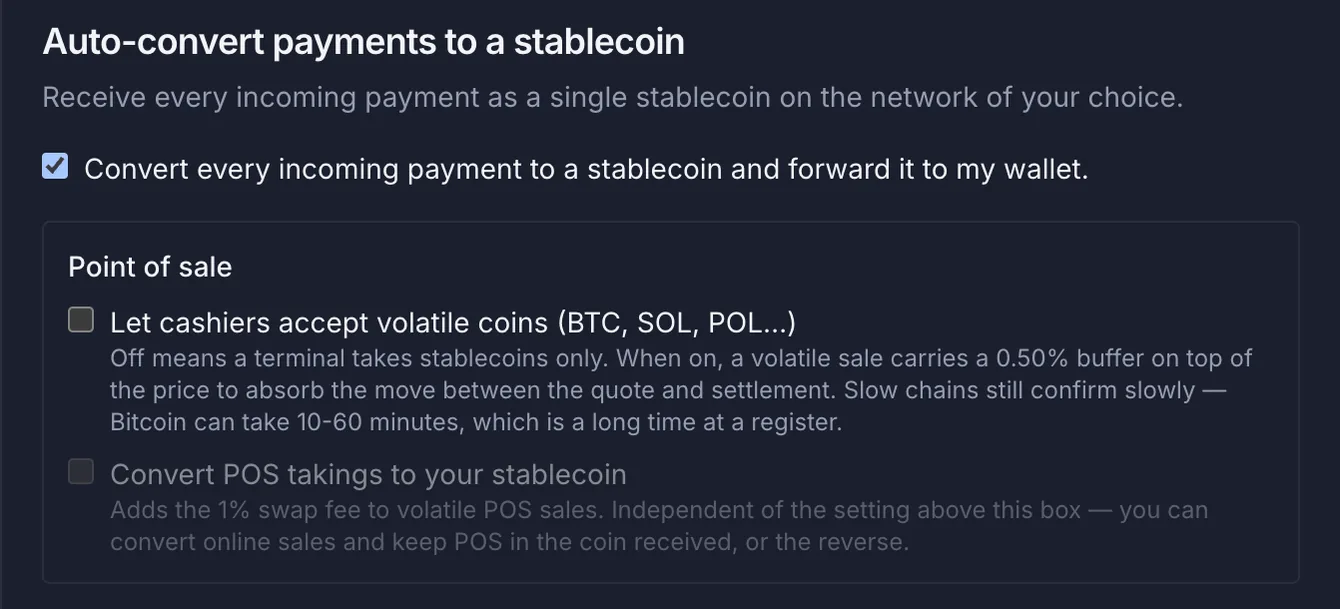
- Pick the coins and networks you accept. Payzum covers Bitcoin, Ethereum, Solana, Polygon, Base, Arbitrum, Optimism, BNB Chain and Avalanche. Decide whether auto-convert should land each sale as USDC or USDT, or leave it in the coin the customer sent.
- Choose the surface. At a counter, the POS shows a new QR for each sale and each staffer signs in with a PIN. For a customer who is not standing in front of you, use a payment link, a hosted checkout or an invoice that expires and flags overpayments.
- Ring a test sale and follow it end to end: the QR, the confirmation, the settlement in the wallet, and the line in the audit log. Then decide which customers you steer to it and which stay on the local QR.
What that costs and what it does not do
Payzum charges 0.5% per processed sale, deducted from the amount received, so a customer who pays 100 leaves you 99.50, plus the network gas paid on-chain. The merchant wallet receives the payment directly and Payzum holds no balance in between, which is why there is nothing for a processor to freeze, reserve or schedule. For the settlement model itself, see how non-custodial processing works.
Payzum is crypto-only. It does not convert to reais, pesos or soles, and it does not settle to a bank account. If your books have to show local currency and your accountant will not touch a wallet, the converter route is the right product for that part of your volume. Published rates on the two routes are compared in crypto payment processing fees in 2026.
Four objections this news will produce in a manager's office
"The customer's bank can take the money back. Why would I accept the QR?"
Because the rules are narrower than a card chargeback and the burden sits on the payer. In Brazil the guide requires evidence that the seller committed the fraud, and it explicitly excludes late delivery and commercial disappointment. On a card, a customer can dispute for roughly 120 days without proving misconduct. The trade is 72 hours of exposure against four months of it.
"If the merchant never touches crypto, why is this a stablecoin story?"
Because the demand being served is a stablecoin balance. The customer already holds dollars in a wallet and had no route to the counter. The converter turns that balance into local currency at the last step. The stablecoin is the funding rail even when the accounting entry is not.
"Is the conversion rate fair?"
Nobody outside the arrangement can say, because Kite publishes no margin. The rate is locked for ten minutes and printed on the receipt, which lets a customer compare it with the mid-market rate. A merchant who wants to know the cost of the rail should ask the partner directly rather than infer it from the customer's screen.
"We already accept cards. Do we need this?"
Only if your customers' cards keep failing, or if the ticket is large enough that a percentage hurts, or if you sell to people whose accounts are in another country. A business with a stable local clientele and a working card rate is not the audience for any of this.
Frequently asked questions
What are stablecoin payments on local QR codes?
They let a customer pay from a USDC or USDT wallet balance by scanning the national QR code a merchant already displays. A settlement partner converts the coin and pays the merchant in local currency through that country's instant payment scheme. Kite and AEON launched this in seven markets on 18 November 2026.
Which countries and QR schemes are covered?
Argentina, Bolivia, Brazil, Colombia, Peru, the Philippines and Vietnam. The schemes named are Pix in Brazil, Bre-B in Colombia, VietQR in Vietnam and QR Ph in the Philippines, plus a local scheme in each of the other three. Nine more countries are planned with no dates.
What are the payment limits?
From 0.65 to 500 US dollars per payment in most launch countries, and from 1 to 400 US dollars in Argentina and Peru. Daily spending is capped at 1,500 dollars and monthly at 50,000 dollars. The exchange rate is locked for 10 minutes.
Does the merchant need a crypto wallet or a new terminal?
No. The merchant keeps the QR code already on the counter and receives local currency in their normal account. There is no app, no account and no hardware to add on the merchant side.
Can a customer take the money back after paying?
On the local rail, disputes follow that country's rules. In Brazil, the Pix MED mechanism lets a receiving bank block funds for up to 72 hours and debit a business account after an accepted fraud report, but the central bank's guide excludes commercial disagreements and requires evidence that the seller committed the fraud. A direct stablecoin payment to your own wallet has no bank in the middle.
How does Payzum compare with the converter route?
The converter pays you local currency and keeps the crypto off your books, at a margin it does not publish. Payzum settles the payment in crypto straight to a wallet you control, for 0.5% of each processed sale taken from the amount received plus network gas, with optional auto-convert to USDC or USDT. Payzum does not convert to local currency or pay into a bank account.
Put your own QR volume on the table
Bring last month's QR and card takings. We will show where a direct stablecoin rail would sit next to the local code, what it costs, and where it would not help you at all.
Calendar not loading? Book a meeting directly · [email protected]
This article analyzes the 18 November 2026 Kite and AEON announcement, the Banco Central do Brasil's Pix refund implementation guide, Banco de la República's draft regulation PR-DSP-008 and dated reporting on Pix and Bre-B volumes. Kite did not publish its conversion margin, fee schedule or merchant settlement partners, and the 1% figure used in the example is an assumption for illustration. Cost and dispute positions differ by country and by contract. This is not financial or legal advice.