
Glassnode's stablecoins in commerce report: merchants get paid on different networks than the busiest ones
Key takeaways
- On November 10, 2026, Glassnode and the processor NOWPayments compared 12 months of merchant pay-ins (September 2025 to September 2026) with on-chain USDT and USDC flows. USDT on Tron, BNB Chain and Ethereum made up 86% of pay-in value.
- The busiest on-chain rail barely shows up at the checkout. USDC on Base carried 45.2% of combined USDT and USDC on-chain value and 0.6% of the processor's merchant settlements.
- Counting active wallets predicted where merchants get paid about twice as well as counting volume.
- Pay-ins peak between 19:00 and 21:00 UTC, which is 2 to 4 p.m. in New York and Bogotá this winter.
- Payzum's network list includes Ethereum, BNB Chain, Base, Solana and Polygon, with payments settling straight to your wallet. Tron is not on it.
What Glassnode's November 10 report measured
On November 10, 2026, the on-chain analytics firm Glassnode published Stablecoins in Commerce, the first report in a series it calls Money in Motion. It was built with NOWPayments, a crypto payment processor. The report puts that processor's merchant pay-in records next to Glassnode's on-chain data for USDT and USDC. The pay-in window runs from September 2025 to September 2026.
Glassnode framed the question in business terms. A company that accepts stablecoins has to pick coins and networks, and that choice "affects who can pay, what funds cost to move and how much operational work they create." Most merchants make it by looking at where the most money moves. This stablecoins in commerce report checks that habit against what merchants received, and the habit does badly.
For scale, the figures compiled by TechFlow from the report put stablecoin supply at $303 billion on October 5, 2026: $184 billion in USDT and $74 billion in USDC. Stablecoins moved $207 billion a day on-chain, on a 30-day average. Bitcoin moved $5.1 billion a day and ether $2.7 billion.
Base leads on volume, Tron and BNB Chain lead at the checkout
USDT on Tron and BNB Chain brought in three quarters of the processor's stablecoin pay-in value. Those two rails carried only 14% of the combined USDT and USDC value that moved on-chain, as TokenPost reported on November 11.
The ranking runs the other way on-chain. The three coin and network pairs with the most on-chain value are USDC on Base, USDC on Ethereum and USDT on Tron, and together they brought in 54% of pay-ins. Put USDT on Ethereum next to Tron and BNB Chain, and USDT across those three networks reaches 86%.
Base is the extreme case. USDC on Base carried 45.2% of combined on-chain value and 0.6% of the processor's merchant settlements. Circle's own figures explain part of the gap. On November 12, 2026, Circle's public circulation data showed $4.40 billion of USDC on Base, 6.3% of the $69.5 billion in circulation. A small balance that changes hands over and over produces huge volume with few shoppers behind it.
Base is also the main settlement chain for machine payments, though they barely move its dollar figure. x402 is the protocol AI agents use to pay for API calls. By November 1 it had processed more than 196 million transactions across 12 chains and settled over $42 million, mostly in USDC on Base, according to Fireblocks data reported by Decrypt. October alone brought 5.1 million payments worth about $274,000. Those agents buy data a few cents at a time, which adds many transactions and very little value. Most of Base's dollar volume comes from other transfers, such as trading.
Tether's numbers show the other side. Its transparency page listed about $175.9 billion of USDT in circulation on November 12, 2026, with $92.2 billion on Tron (52.4%) and $79.7 billion on Ethereum (45.3%). BNB Smart Chain showed zero tokens issued by Tether. The USDT people send on BNB Chain is a pegged version that Tether does not mint there, which is worth knowing if you ever deal with the issuer directly.
Why wallet counts predict the checkout better than volume
The report's most useful line for a merchant is about method. Counting on-chain users matched where merchants get paid about twice as well as counting volume. One purchase is one person paying once. Volume is dominated by the few wallets that move the most money: exchanges, market makers, arbitrage bots and treasury desks.
So if you have no data of your own yet, the better proxy is where ordinary wallets sit and which network your customers' exchanges offer by default for withdrawals. Replace the proxy with your own receipts once you have three months of them.
The mix also moves. In the processor's numbers covered by Crypto Briefing, USDT was 66.92% of stablecoin transaction volume in the first half of 2026, but that volume fell 14.99% year on year. USDC transaction counts rose 209.02% over the same period. A menu that fit your buyers last year may not fit them next year.
The wider market was shrinking that same week. Crypto Briefing reported on November 10 that USDT's market cap had fallen about $6.6 billion in 60 days, to roughly $177 billion. The week to November 7 alone saw a $3.1 billion drop, the largest weekly fall of 2026. Both coins held their pegs, with USDT near $0.9989 and USDC near $0.99945 on November 8. A smaller USDT supply does not, by itself, change which token your buyers pay with this month.
A network-coverage worksheet built from the report
The table puts the report's public figures in one place, next to Payzum's network list. Use it as a starting sheet, then replace the pay-in column with your own receipts.
| Coin and network | Share of on-chain USDT + USDC value | Share of merchant pay-in value (one processor, Sep 2025 to Sep 2026) | On Payzum's network list |
|---|---|---|---|
| USDC on Base | 45.2% | 0.6% | Yes |
| USDT on Tron and BNB Chain, combined | 14% | 75% | BNB Chain yes, Tron no |
| USDT on Tron, BNB Chain and Ethereum | Not published | 86% | BNB Chain and Ethereum yes, Tron no |
| Top three by on-chain value: USDC on Base, USDC on Ethereum, USDT on Tron | The three largest | 54% | Base and Ethereum yes, Tron no |
| USDT on Ethereum, implied (86% minus 75%) | Not published | 11% | Yes |
Two things follow from the table. First, a menu built from on-chain rankings misses close to half of what this processor's merchants received. Second, the public summary does not split Tron from BNB Chain. Nobody can tell from it how much of that 75% a menu without Tron would capture, though your own records will show it.
Worked example: a $50,000 month under two network menus
Take an online store that receives $50,000 a month in stablecoins and whose buyers pay like the processor's sample. Compare a menu copied from on-chain rankings with one copied from checkout data. Assume one in four buyers gives up when asked to switch network or coin. That rate is an assumption, so swap in your own.
| Menu | Rails accepted | Pay-in value already on those rails | Value that must switch | Lost if 1 in 4 switchers leave |
|---|---|---|---|---|
| Follow the volume | USDC on Base, USDC on Ethereum, USDT on Tron | $27,000 (54%) | $23,000 | $5,750 |
| Follow the checkout | USDT on Tron, BNB Chain and Ethereum | $43,000 (86%) | $7,000 | $1,750 |
On these assumptions the gap is $4,000 a month, or $48,000 a year, without a single price change. The fee side is the same under either menu. Payzum takes 0.5% of each processed sale from the amount received, so a $1,000 USDT payment on BNB Chain lands as $995 in your wallet, less the network gas.
Both menus include Tron, and Payzum does not support it. A merchant whose own data looks like the second menu should ask how many Tron payers can move. Buyers who hold USDT on an exchange can usually pick another withdrawal network, such as BNB Chain or Ethereum. Buyers who keep USDT in a Tron wallet would have to bridge it first, and some will not bother.
Staffing support for the 19:00 to 21:00 UTC pay-in peak
Pay-ins on the largest rails peak between 19:00 and 21:00 UTC, hours after on-chain activity peaks. Glassnode's hourly series covers the 39 full weeks to October 4, 2026. For a merchant, those are the hours when wrong-network sends, short payments and "where is my order" messages arrive.
- New York and Bogotá: 2 to 4 p.m.
- Mexico City: 1 to 3 p.m.
- São Paulo and Buenos Aires: 4 to 6 p.m.
- Madrid and Lagos: 8 to 10 p.m.
In Madrid the peak falls after a normal shift ends. If your buyers are in the Americas and your team works from Europe, move one person's hours or set an on-call rule for those two hours. Our guide to an underpaid crypto invoice covers the most common ticket in that window.
What one processor's numbers can't tell a merchant
The report is careful about its limits, and a merchant should be too. The pay-in figures come from one processor's merchants, and Crypto Briefing notes they may lean toward certain regions, networks or industries. Glassnode says the full report breaks the mix down across trading, e-commerce, SaaS and iGaming merchants. Buyers on a trading desk behave differently from a clothing shop's, and the public summary does not publish those splits.
The figures also measure value, so a handful of large USDT payments can outweigh hundreds of small USDC ones. If most of your revenue comes from a few big clients, ask them directly. If it comes from many small orders, count how many people pay on each network.
On-chain value carries its own noise. It includes exchange flows, trading and transfers between a company's own wallets. Glassnode makes the point itself in the report's outline: a transfer on a blockchain is not a payment.
Where Payzum covers the report's rails, and where it doesn't
Payzum is a non-custodial processor. A customer's payment goes straight to a wallet you control, and Payzum never holds the money. Its network list covers Ethereum, BNB Chain, Base, Solana, Polygon, Arbitrum, Optimism and Avalanche, plus Bitcoin. In the report's terms, that includes USDT on BNB Chain and Ethereum, and USDC on Base and Ethereum.
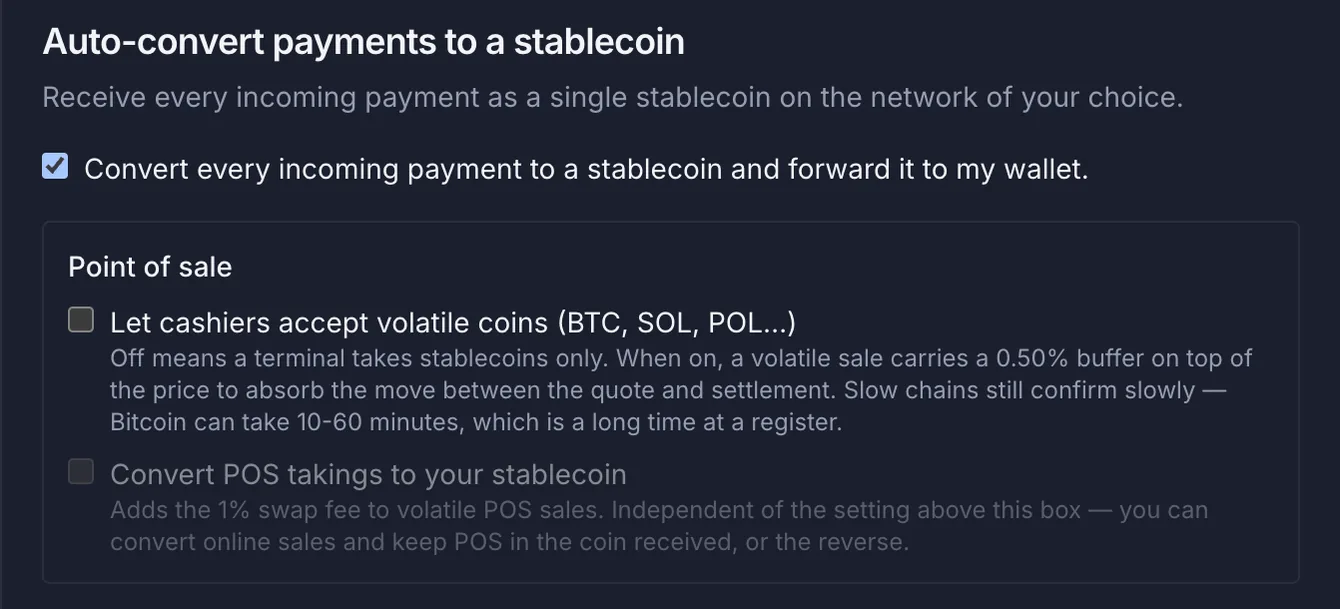
You can take those payments through hosted checkout, payment links, invoices that expire and flag overpayments, or open-source plugins for carts such as WooCommerce, Shopify and Magento. In a physical shop, the POS shows a new QR code for each sale and cashiers sign in with a PIN. If some buyers pay in volatile crypto instead, optional auto-conversion turns those payments into USDC or USDT.
Tron is the gap. If your receipts look like this processor's, find out how many Tron payers can switch before you sign up anywhere. We would rather you know that before a call than after one.
Base fits a different job. If the Base traffic you see is AI agents, Payzum's x402 setup lets them pay USDC on Base per API call straight to your wallet. Payzum sits in front of your API as middleware and settles through an external facilitator, currently Coinbase's. For a wider view of the market, see our guide to the best crypto payment processors in 2026. For the coin decision itself, read USDT vs USDC for payments, and for fees by chain, the cheapest network for USDT payments.
Five checks before you change your network menu
- Pull 90 days of receipts and count both value and payers for each coin and network pair.
- Read your failed and wrong-network payments. They show which rails buyers tried to use that you did not offer.
- Offer each coin on at least two networks, so one congested or retired chain doesn't stop a sale. Networks do get switched off, as the end of USDC on Noble showed.
- Price the whole route: gas to receive, any conversion spread and the cost of moving funds out.
- Check again every quarter. In the processor's data, USDC transaction counts tripled in a year.
Frequently asked questions
What is Glassnode's Stablecoins in Commerce report?
A report published on November 10, 2026 by Glassnode with the processor NOWPayments. It compares 12 months of merchant stablecoin pay-ins, from September 2025 to September 2026, with on-chain USDT and USDC flows. It is the first report in Glassnode's Money in Motion series.
Which stablecoin networks do merchants get paid on most?
In this processor's data, USDT on Tron and BNB Chain brought in 75% of stablecoin pay-in value, and USDT on Tron, BNB Chain and Ethereum brought in 86%. Your own mix may differ, so count your receipts.
Why does USDC on Base move so much value but bring in few merchant payments?
Base carried 45.2% of on-chain USDT and USDC value but 0.6% of the processor's merchant settlements. A small USDC balance there changes hands many times, mostly in transfers that are not purchases, such as trading. That pushes volume far ahead of shopping.
Does Payzum accept USDT on Tron?
No. Tron is not on Payzum's network list. Payzum accepts payments on Ethereum, BNB Chain, Base, Solana, Polygon, Arbitrum, Optimism, Avalanche and Bitcoin, settled straight to your own wallet, for 0.5% of each processed sale plus network gas.
When do stablecoin payments to merchants peak?
Between 19:00 and 21:00 UTC on the largest rails, according to the report. That is 2 to 4 p.m. in New York and Bogotá in winter, and 8 to 10 p.m. in Madrid.
Bring your receipts, leave with a network menu
The report's advice comes down to accepting what your buyers already hold. Book 20 minutes with our team and bring your payment mix. We will show which of your rails Payzum covers today and where Tron leaves a gap.
Calendar not loading? Book a meeting directly · [email protected]
This article analyzes Glassnode's public summary of Stablecoins in Commerce (November 10, 2026) and coverage by Crypto Briefing, TokenPost and TechFlow. The full PDF sits behind a sign-up form and was not reviewed. Tether's and Circle's circulation figures were read on November 12, 2026. Pay-in shares describe one processor's merchants, not the whole market. This is not financial or legal advice.