
Stablecoin vs Card Settlement Time: When Does the Money Reach You?
Key takeaways
- Stripe's published US schedule is 2 business days from the charge. The first payout on a new account typically takes 7 to 14 days.
- A Base payment is in a block in about 2 seconds. A Solana payment is final in roughly 13 seconds. Neither waits for a business day.
- Fast settlement is not the same as no risk. A card payment can be disputed for about 120 days. An on-chain payment cannot be pulled back by the customer's bank.
- Stablecoins in a wallet are not cash in a bank account. Moving them to a bank is a separate step with its own timing.
A Friday sale: when does $240 become spendable?
Take a shop that sells a $240 order at 4:30 pm on a Friday. The question behind stablecoin vs card settlement time is simple: on which day can the owner use that money to pay a supplier?
With a card, the answer depends on the processor's schedule, the weekend, the bank that receives the payout and the age of the account. With a stablecoin sent to the shop's own wallet, the answer is Friday, a few minutes after the customer pays.
This guide follows that one order through both paths with the windows each system publishes. It is a snapshot taken on 26 October 2026, built from the documentation of Stripe, Base, Solana and the US Consumer Financial Protection Bureau. Payzum is a non-custodial, stablecoin-first crypto payment processor: payments settle directly to wallets the merchant controls.
Why a card payment takes days to turn into money
A card payment is a promise before it is money. The issuer approves the charge, which only reserves the amount on the customer's card. The merchant captures it, the networks clear it, and the processor pays the merchant out on a schedule. Each step belongs to a different company, and each one works on business days.
That is why the owner of our $240 order sees a sale on Friday and a payout on Tuesday at the earliest. Saturday and Sunday do not count, and neither does any bank holiday in between.
The processor keeps the money for a few days because the sale can still go wrong. The customer may dispute it, the card may turn out to be stolen, or the merchant may not deliver. The waiting period is the processor's cushion against those cases.
Three things that stretch the card clock
The headline figure of two business days is the best case. Three situations push it out, and small merchants meet all three.
- The account is new. Stripe's payout documentation says the first payout after a first live payment typically completes within 7 to 14 days, depending on industry, country and risk level.
- The country has a longer schedule. The same documentation lists 7 calendar days at first and then 3 business days for Canada and many European countries, and 30 calendar days for domestic Brazilian card payments.
- The bank adds time. Stripe notes that the bank may need more time to make funds available after it receives them.
The card clock, step by step, with Stripe's published windows
Stripe documents its timing in public, so it makes a fair reference. The numbers below come from its payout, authorization and dispute pages as read on 26 October 2026. Other processors differ in detail but follow the same shape.
- Authorization. The issuer approves the charge and holds the amount. Stripe's authorization table lists a validity window of 7 days for most online card payments and 2 days for most in-person ones. A merchant who never captures the payment loses the hold when the window ends.
- Capture. For a normal sale the capture happens at once, so this step adds no delay.
- Settlement timing. Stripe expresses it as T+X. For the United States it lists 2 business days.
- Payout. Funds move to the merchant's bank on the account's schedule, which can be daily, weekly or monthly. Manual payouts typically take 1 to 4 business days to arrive, with same-day options in a few regions under conditions.
Stripe also states that settlement and payout are separate things. Funds become available on the settlement date, and the bank then needs its own time. A merchant who picks weekly payouts waits up to a week on top of that.
The stablecoin clock: seconds on Base, about 13 seconds finalized on Solana
An on-chain payment has no authorization, capture or clearing step. The customer signs a transfer from their wallet, the network includes it in a block, and the funds sit in the destination wallet. The only question is how sure you want to be before you hand over the goods.
Base publishes a finality timeline. A transaction is included in a preconfirmation block after roughly 200 milliseconds. It is in an L2 block within about 2 seconds. The batch is posted to Ethereum after about 2 minutes and becomes final on Ethereum after about 20 minutes. Base notes that the 5-day window applies to withdrawals back to Ethereum, not to payments received on Base.
Solana's developer guide says slots last about 400 milliseconds, and the finalized level typically sits at least 32 slots behind the confirmed one. That is roughly 13 seconds, which matches the guide's own note that finalized reduces the usable lifetime of a transaction by about 13 seconds.
Payzum lists nine networks, and confirmation time differs by chain. Our USDC transfer speed by network guide compares them in one table. Payzum is non-custodial, so a confirmed payment is already in your wallet, with nothing to release on a later date.
Friday 4:30 pm to Tuesday: the two clocks side by side
Here is the $240 order from the opening, run through both paths. For the stablecoin path, Payzum takes 0.5% of the sale from the amount received, so the shop receives $238.80, before the few cents of network gas on a chain such as Base. The card column shows timing only. It leaves fees out, because processors price them differently.
| Moment | Card payment (US, 2-business-day schedule) | USDC on Base through Payzum |
|---|---|---|
| Fri 4:30 pm, customer pays | Issuer approves and holds $240 on the card | Customer sends USDC from their wallet |
| Fri 4:30 pm plus 2 seconds | Nothing has moved to the merchant | Payment included in a Base block |
| Fri evening | Sale is captured and waits for settlement | $238.80 in the shop's wallet; order can ship |
| Sat and Sun | Weekend; no settlement | Funds usable, the chain does not close |
| Mon | Business day 1 of 2 | Same funds, already in use if the owner chose |
| Tue | Business day 2: funds available, bank may add more time | Four days earlier than the card |
| New account, first sale | First payout typically 7 to 14 days | No payout step; same Friday timeline |
The gap is largest at the weekend. A Friday afternoon sale is the common case for retail and food businesses, and the one where the card clock runs longest.
One caveat belongs next to this table. The right-hand column ends with stablecoins in a wallet. If the shop needs dollars in a bank account to pay rent, it has to move them there, and that last step runs on its own timing with a provider you choose. Payzum is crypto-only and does not settle to a bank account. The speed advantage holds for suppliers, contractors and anyone else you can pay in stablecoins.
Settled is not the same as safe: the 120-day tail
A card payout that arrives on Tuesday is not final on Tuesday. Stripe's dispute documentation says card networks typically let cardholders start a dispute within 120 days of the original payment, and longer in some cases. When the payment covers a future event or service, the window can start on the event date.
If a dispute opens, the network pulls the disputed amount from the merchant's balance, and the processor adds a dispute fee. Stripe says the full dispute lifecycle can take 2 to 3 months. The merchant who thought the $240 was theirs on Tuesday may be waiting on it again months later.
Regulation sets a separate clock for credit cards. Under Regulation Z, a consumer must give notice of a billing error within 60 days after the first statement that shows it, and the card issuer must resolve it within two billing cycles and no later than 90 days.
An on-chain stablecoin payment has no equivalent. Once the network confirms it, the customer's bank has no mechanism to reverse it. That is the other half of the settlement story. The merchant gets the money sooner and also gets it for good. Refunds still exist: the merchant sends a new payment. Our guide to reducing chargebacks in an online store covers what to do on the card side while you still use cards.
A customer can still send the wrong amount or use the wrong network, and a merchant can still deliver a bad product. The difference is that the remedy is a conversation and a refund payment, not a forced debit months later.
What changes in your week when payment lands in minutes
- A food truck that rings up $14 and $22 orders on the Payzum POS sees each sale in its wallet before the next customer steps up. A card terminal batches those sales into a payout days later.
- A freelancer who invoices $1,800 on a Thursday pays a subcontractor in stablecoins on Friday morning. With a card or bank transfer, the funds would arrive after the weekend.
- A small online shop that ships on payment confirmation fulfils orders the same hour, with the money already in hand. It stops floating inventory cost for four or five days.
- A SaaS with annual plans collects a $2,400 renewal at the start of the month and has it for payroll the same day, not after a settlement lag plus a reserve.
For the question of when to hand over goods, see stablecoin settlement vs acceptance, which looks at the difference between a payment being visible and being final.
Card payout or stablecoin to your wallet: the timing and the strings
| Question | Card through a processor | Payzum with stablecoins |
|---|---|---|
| Time to usable funds | 2 or more business days; 7 to 14 days for a first payout | Seconds to minutes, depending on the network |
| Weekends and holidays | Do not count | The network runs all day, every day |
| Who holds the money meanwhile | The processor | Nobody: the payment goes to your wallet |
| Can the customer reverse it | Yes, typically within 120 days | No: confirmed on-chain payments are final |
| Fee | Set by the processor | 0.5% of the sale, taken from the amount received, plus network gas |
| Money in a bank account | Yes, on the payout schedule | No: you hold crypto and convert it yourself if you need cash |
Objections about stablecoin settlement
"My bank account is where the money has to end up."
For many merchants that is true, and it is the honest limit of this comparison. Payzum settles in crypto. If rent and payroll must be paid in a local currency, you add a conversion step you control. The speed gain then applies to everything you can pay directly in stablecoins, and the conversion runs on the exchange's schedule, not on a card processor's.
"Fast also means fast for mistakes."
Yes. A wrong network or a typo in an address cannot be recalled. Payzum creates a new QR and amount for each payment with an expiry, which keeps the customer on the right path. Tell customers which network to choose, and keep a refund policy that sends a new payment to an address they confirm.
"The price of the coin can move before I spend it."
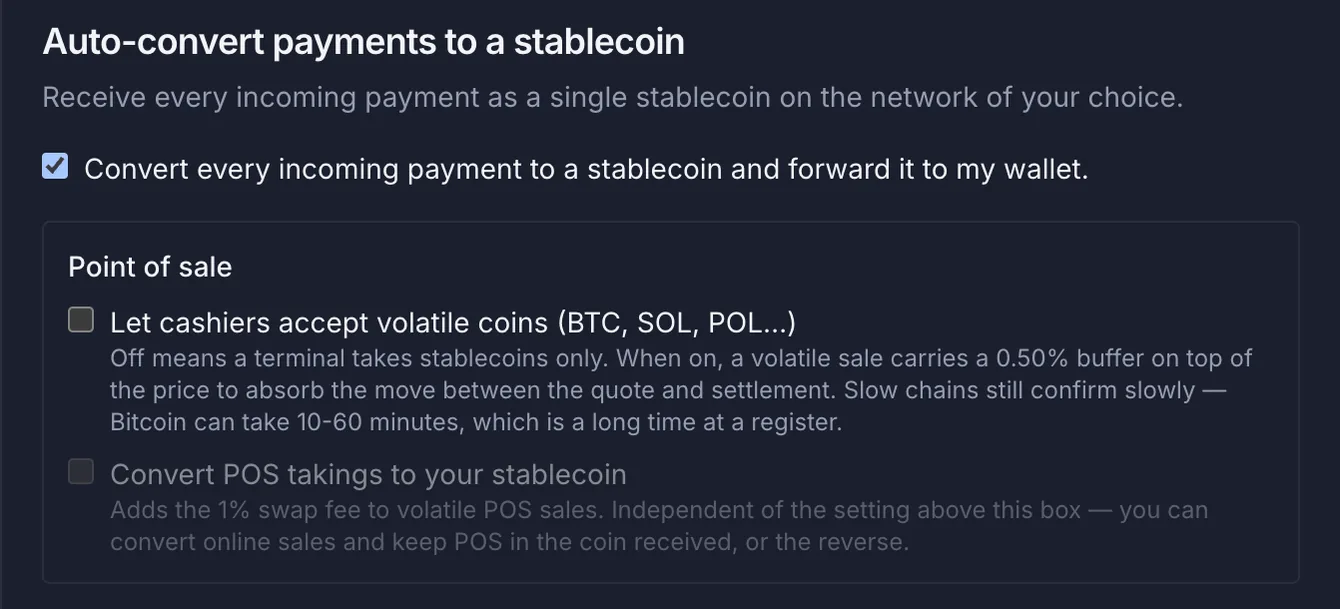
Not if the coin is a stablecoin. Payzum can auto-convert to USDC or USDT on most supported networks, and the conversion is optional. A merchant who does not want exposure to volatile coins can keep it on.
"The customer needs a wallet and a little gas."
Often true for self-custody wallets, which pay the network fee in the chain's own token. Customers who pay from an exchange avoid that, because the exchange charges its own withdrawal fee. Our cheapest network for USDT payments guide shows what the fee looks like by chain.
Questions about settlement time
How long does a card payment take to reach the merchant?
Stripe's published schedule for the United States is 2 business days after the charge, and the first payout on a new account typically takes 7 to 14 days. Other countries and other processors use different schedules, and the bank can add time after the payout is sent.
How long does a stablecoin payment take to settle?
It depends on the network. Base includes a transaction in a block in about 2 seconds, and Solana finalizes in roughly 13 seconds. The funds arrive in the merchant's own wallet, with no processor schedule between the payment and the merchant.
Is a faster settlement the same as a safer one?
No. Speed and finality are separate. A card payment can be disputed for about 120 days after the sale. An on-chain stablecoin payment cannot be reversed by the customer's bank once it is confirmed, which also means mistakes need a refund payment.
Does Payzum pay me in dollars to my bank?
No. Payzum is crypto-only and non-custodial: payments go to wallets you control, and you can auto-convert to USDC or USDT. Turning stablecoins into bank money is a separate step with a provider you choose.
What does Payzum charge for a faster payout?
Payzum charges 0.5% per processed sale, taken from the amount received, plus on-chain network gas. A customer who pays 100 USDC leaves the merchant with 99.50 USDC before gas.
Map your payout calendar to your sales calendar
Every business has its own gap between a sale and usable money. Book 20 minutes with the Payzum team and we will walk through your sales pattern, your payout schedule and how payments would land in your wallet.
Can't see the calendar? Book directly here · [email protected]
Sources read on 26 October 2026: Stripe payouts, Stripe authorization windows, Stripe dispute timing, Base transaction finality, Solana confirmation guide and CFPB Regulation Z, section 1026.13.