
USDC Transfer Speed by Network: Solana, Base, Polygon and More
Key takeaways
- Speed has two meanings: the first confirmation your customer sees, and the point where the payment cannot be rolled back. Chains differ most on the second one.
- On the networks merchants use most, the first confirmation takes 0.2 to 2 seconds. Ethereum mainnet is the slow outlier at 12-second blocks.
- Payzum is a non-custodial, stablecoin-first crypto payment processor: payments settle directly to wallets the merchant controls. Its typical confirmations are Solana about 0.4 s, Base about 2 s and Polygon about 2 s.
- You choose how long to wait before handing over goods. A coffee and a $5,000 invoice should not use the same rule.
How fast is a USDC payment on Solana compared with Base and Polygon?
For a shopper at a counter, the three feel almost the same. Scan, approve, done. Solana targets slots of about 400 ms, Base builds a regular block every 2 seconds, and Polygon PoS reaches deterministic finality in 2 to 5 seconds. The spread between them is a few seconds, and nobody notices a few seconds at a checkout.
The gap shows up in a different place. Ask each network "can this payment still be undone?" and the answers range from "almost never, and we will say so in about a second" to "yes, for the next quarter of an hour". Finance teams care about that number, and most speed charts omit it.
This guide uses each chain's own documentation as of October 2026. It covers the six networks merchants ask about most (Solana, Base, Polygon, Arbitrum, Avalanche and BNB Chain), with Ethereum mainnet as the yardstick.
Three clocks hide inside "transfer speed"
Most speed claims blur three separate events. Keeping them apart makes the rest of this page easy to read.
- Inclusion. A block producer has put the payment in a block. The customer's wallet shows "sent". It can still be dropped if that block is replaced.
- Confirmation. A supermajority of validators has voted for the block. Solana calls this "confirmed". Rollbacks are very unlikely but not ruled out by the protocol.
- Finality. The protocol itself guarantees the block stays. Solana calls it "finalized", Ethereum uses checkpoints, Polygon uses milestones.
Solana's documentation puts a number on the gap between the second and third clock: typically at least 32 slots, which is roughly 13 seconds at 400 ms per slot. The same page notes that slots may stretch between 400 and 600 ms, so treat 13 seconds as a floor rather than a promise.
Network by network: block time, first confirmation and final
| Network | Block or slot time | Confirmed or fast signal | Final (per its own docs) |
|---|---|---|---|
| Solana | about 400 ms (400 to 600 ms) | "Confirmed": more than two-thirds of stake has voted | "Finalized": at least 32 slots later, about 13 s |
| Base | 2 s, with Flashblocks every 200 ms | Flashblocks preconfirmation in about 200 ms | Ethereum-level finality follows the L1 posting schedule |
| Polygon PoS | 1 to 2 s on the Heimdall layer | Block seen on the network in about 2 s | Deterministic, 2 to 5 s |
| Arbitrum One | sub-second sequencer feed | Soft finality, sub-second | Batch on Ethereum in about 12 to 15 min; full L2 settlement is days |
| Avalanche C-Chain | Snowman consensus, no fixed slot | about 1 s acceptance | Sub-second, irreversible once accepted |
| BNB Chain | 0.45 s since the Fermi fork (Jan 14, 2026) | about 1 s with fast finality | about 1 s |
| Ethereum mainnet | 12 s slots | 1 slot, about 12 s | Two epochs of 32 slots, about 12.8 min |
Sources: Solana confirmation guide, Base block building docs, Polygon PoS finality docs, Arbitrum finality docs, Avalanche consensus docs, BNB Chain Fermi announcement and ethereum.org proof-of-stake. Checked October 21, 2026. The Ethereum figure is our arithmetic from the page's 12-second slots and 32-slot epochs.
Solana
Solana gives a first signal a merchant can trust in well under a second. A "confirmed" block has been voted on by more than two-thirds of active stake. Solana's own guide recommends the confirmed level for most requests because it balances freshness and stability. The same guide says roughly 5% of blocks never reach finalization, which is why a shop that ships expensive goods should look at "finalized", not just "confirmed". For a deeper look at merchant use, see Solana stablecoin payments for merchants.
Base
Base builds a regular block every 2 seconds and adds Flashblocks, which the docs describe as preconfirmations every 200 ms. A preconfirmation tells the customer's app that the payment is queued and ordered. It is a promise from the sequencer, not yet the Ethereum-level guarantee. For tiny and mid-sized tickets, that promise is enough for most shops. Payzum lists Base confirmations at about 2 seconds.
Polygon PoS
Polygon's Heimdall v2 upgrade went live in July 2025 and moved the network to deterministic finality in 2 to 5 seconds, with 1 to 2 second block times on the Heimdall layer. Before the upgrade, finality was tied to checkpoints sent to Ethereum. The docs now describe a milestone mechanism that finalizes first and checkpoints later. For a merchant, that means Polygon is one of the few EVM networks where "final" and "fast" are in the same sentence.
Arbitrum
Arbitrum's sequencer gives sub-second soft finality. The batch containing your payment lands on Ethereum in about two epochs, which Arbitrum's docs put at 12 to 15 minutes. Full settlement of L2 state, the kind that matters for bridging back to Ethereum, takes days under the BoLD challenge protocol. A merchant receiving USDC on Arbitrum and keeping it there rarely cares about the last step. A merchant bridging to mainnet does.
Avalanche C-Chain
Avalanche's docs describe sub-second, immutable finality and around one second of acceptance latency. Once the network accepts a block, it does not come back. Independent guides quote one to two seconds in practice, so plan on "a second or two".
BNB Chain
On January 14, 2026, the Fermi hard fork cut BNB Chain's block interval from 750 ms to 450 ms. Press coverage of the upgrade puts finality at about one second. BNB Chain is also a payout network on Payzum, so the speed helps both when you collect and when you pay out.
What "final" means to a florist, a gym and a freelancer
Speed matters differently by business. Here is how three small merchants would read the same table.
- A florist takes a $45 bouquet. The customer scans a QR code, the phone shows "paid" in about two seconds on Base, and the bouquet goes across the counter. Reversal risk on a $45 sale is not worth a delay.
- A gym sells a $480 annual pass. The front desk waits for the chain's own final label. On Polygon that is up to 5 seconds, on Solana about 13. The member signs the form while it settles.
- A freelancer sends a $6,200 invoice. The client pays from an exchange, which batches withdrawals. The freelancer cares less about seconds and more about seeing the right amount arrive on the right network. See how to accept USDC payments online.
A ticket-size ladder for when to hand over the goods
Many merchants treat speed as a switch: paid or not paid. A ladder fits better. The tiers below are an illustration, not a Payzum rule. Your own risk appetite sets the real numbers.
| Ticket | Example | Act on this signal | Typical wait |
|---|---|---|---|
| Under $50 | Coffee, bouquet, download | First confirmation | 0.4 to 2 s |
| $50 to $1,000 | Online order, gym pass | The chain's own final label | 2 to 15 s on Polygon, Avalanche, BNB Chain or Solana |
| $1,000 to $10,000 | Invoice, deposit | Final label plus a check of amount and network | Seconds, then a human look |
| Over $10,000 | Equipment, B2B order | Final label, then release | Minutes on Arbitrum or Ethereum if you bridge |
The point of the ladder is that waiting costs money too. A shop that insists on Ethereum-level finality for a $4 coffee loses sales. A shop that ships a $9,000 order on a first confirmation takes a risk it did not need to take.
How Payzum fits the speed picture
Payzum is a non-custodial processor. The customer pays on the network you choose, and the funds go straight to a wallet you control. Payzum never holds the money, so no internal ledger delay adds to the chain's own speed.
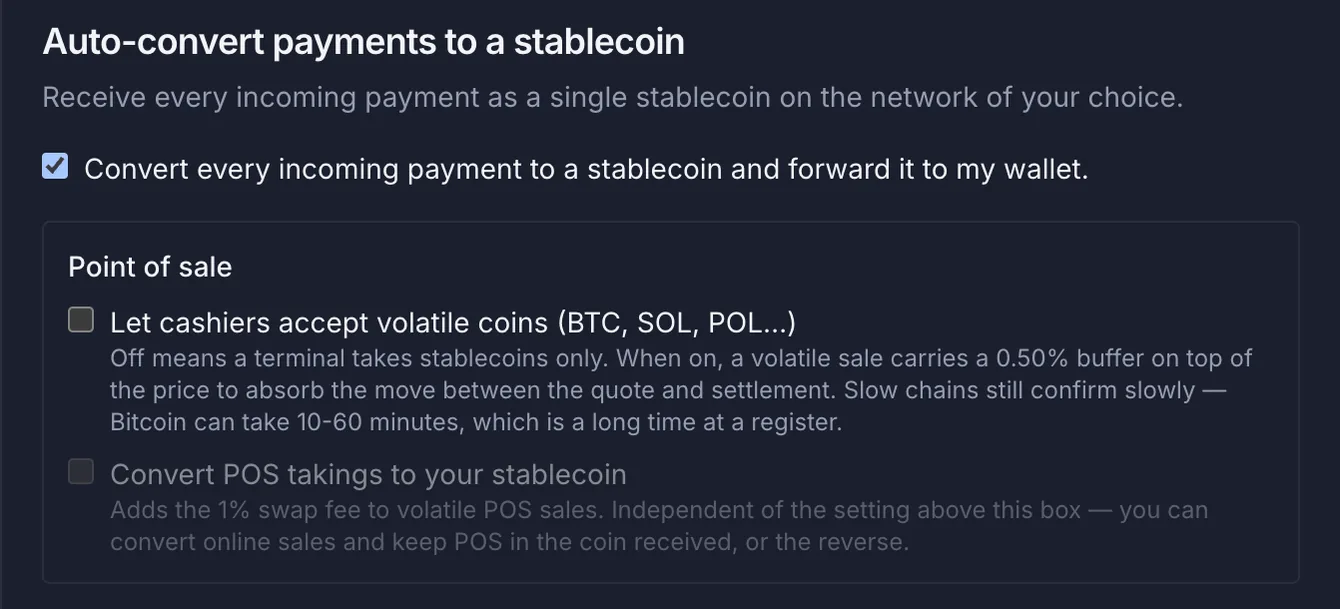
The processing fee is 0.5% per sale, deducted from the amount received: the customer pays 100 USDC and the merchant receives 99.50. Network gas is paid on-chain and runs to cents on Base, Polygon and Solana. If you want dollars only, auto-convert to USDC or USDT is optional on most supported networks.
Cards work on a different clock. Authorization is instant, but money reaches the merchant in 1 to 3 days, and a chargeback can pull it back for around 120 days. Our post on stablecoin settlement versus acceptance looks at the same gap from the news side.
Setting up the right network, step by step
- Create a merchant account at merchant.payzum.com and add the wallet that will receive funds.
- Pick the networks you will accept. Start with the ones your customers already use, usually Base, Polygon or Solana.
- Choose how you collect: payment link, hosted checkout, drop-in plugin, invoice or POS QR code.
- Decide your release rule using the ladder above, and write it down for staff.
- Run a small test payment on each network and watch when it shows as paid.
For in-store sales, the POS makes a fresh QR code per sale and any phone works as a terminal. Cashiers sign in with a PIN, and there are no chargebacks. For payouts, EVM stablecoin payouts run on Polygon, Arbitrum, Optimism, Base, BNB Chain and Avalanche. The trade-offs for batches are covered in mass payouts on Polygon, Arbitrum and Base.
Use cases where seconds change the outcome
- A food truck line moves faster when the cashier sees "paid" before the customer has put the phone away.
- A ticketing desk releases a QR entry code as soon as the payment is final, so the queue never stalls.
- An API provider charging AI agents per call uses USDC on Base, where about 2 seconds per request is workable. The model is explained in USDC on Base per request.
- A marketplace pays sellers on a schedule and picks the cheapest, fastest network for the batch.
Payzum versus a card acquirer on the timeline
| Question | Card acquirer | Payzum on USDC |
|---|---|---|
| Customer sees "paid" | Instant authorization | 0.2 to 2 s on Solana, Base, Polygon, Avalanche, BNB Chain |
| Money reaches the merchant | 1 to 3 days, often held back in reserve | Straight to the merchant's own wallet, as soon as the chain confirms |
| Can the payment be reversed? | Chargebacks for around 120 days | No chargebacks; on-chain finality |
| Who holds the funds meanwhile? | The acquirer | Nobody: the merchant's wallet receives them |
Objections about speed and finality
"If Ethereum takes 13 minutes, is Base unsafe?"
No. Base and Arbitrum are layer 2 networks. They order transactions in milliseconds and post data to Ethereum later. The 12 to 15 minute figure on Arbitrum's docs refers to that posting step. Merchants who keep USDC on the L2 do not wait for it, and merchants with big tickets can choose a quicker-final network such as Polygon, Avalanche or BNB Chain.
"Solana says 'confirmed'. Is that enough for my store?"
For low and mid tickets, most merchants say yes. Solana's own guide notes that about 5% of blocks never finalize, so a store with expensive goods should wait for "finalized", about 13 seconds more.
"Do faster chains cost more?"
Not in any consistent way. On Base, Polygon and Solana gas runs to cents, so a fast confirmation costs little. Payzum's own fee is 0.5% per sale, whichever network you pick.
Questions merchants ask about USDC speed
How fast is a USDC payment on Solana compared with Base and Polygon?
On Solana, the first confirmation arrives in about 0.4 seconds and finality about 13 seconds later. Base confirms in about 2 seconds, with 200 ms Flashblocks preconfirmations. Polygon PoS reaches deterministic finality in 2 to 5 seconds. All three feel instant at a checkout.
What is the fastest network to receive USDC?
BNB Chain, Avalanche and Solana lead on first confirmation, at about 0.45 to 1 second. For finality, Polygon, Avalanche and BNB Chain finish within about 5 seconds, ahead of Solana at about 13 seconds. Pick the network your customers already hold USDC on.
How long until a USDC payment is final?
It depends on the network. Polygon says 2 to 5 seconds. Avalanche and BNB Chain say about 1 second. Solana is typically at least 32 slots, about 13 seconds. Ethereum needs two epochs, about 12.8 minutes. Arbitrum posts to Ethereum in 12 to 15 minutes.
Does Payzum hold my USDC while it confirms?
No. Payzum is non-custodial. The payment goes to a wallet you control, so there is no balance at Payzum to wait on or to freeze.
Can a confirmed USDC payment be reversed?
There are no chargebacks on-chain. A payment is only at risk before the network finalizes it. That window is about a second or two on the fastest networks and longer on Ethereum. After finality, a refund is a new payment you send back.
Choose the network and the waiting rule for your checkout
Every checkout has its own mix of ticket size, customer wallets and risk. Book 20 minutes with the Payzum team and we will help you pick the right network and set up the collection flow for your case.
Can't see the calendar? Book directly here · [email protected]