
AWS Marketplace x402: agents now pay per call on the AWS bill, and the seller gives up 3%
Key takeaways
- AWS now sells per-request AI products to agents and puts the charge on the buyer's AWS invoice. The buyer needs no wallet, no sign-up and no API key from the seller.
- The seller's cost is a 3% listing fee on the contract value, plus additive regional fees, plus a month of float before the disbursement lands.
- At launch the rail carries signed fixed-price quotes in US dollars and nothing else, in a separate listing that cannot offer private offers or a free tier.
- Volume is still small enough that this is a distribution decision, not a revenue one. Two credible measurements of the same market differ by more than 40x.
Two things happened in the same week, and read together they explain why the agent payment market confuses people. On November 19, AWS turned x402 into a procurement channel: an agent can buy a per-request product listed on AWS Marketplace and charge it to the company's cloud bill. On November 24, Visa's crypto lead told a podcast that on-chain agent payments across both major protocols add up to roughly $50,000 a week, flat for six to eight months.
Both figures describe different things. One is where the shelf is being built, the other is how much sits on it today. A seller of APIs, data or model inference faces a narrower question than the headlines suggest: list on AWS Marketplace and hand over 3% for enterprise reach, or publish your own endpoint and keep the whole call.
What AWS Marketplace x402 switched on, and the four limits the seller inherits
The launch adds AWS Billing as a payment option inside Amazon Bedrock AgentCore payments. A buyer's agent hits a seller's endpoint, receives HTTP 402 with a signed quote, forwards that quote to AgentCore, and gets a payment token in return. The agent retries with the token and the seller serves the response. The charge appears on the buyer's AWS bill as a Marketplace line item.
AWS published the mechanics in a technical post on November 19, 2026, alongside a companion Marketplace announcement. The seller documentation is where the constraints live, and four of them change what you can sell:
- Fixed price only. AWS Billing supports the x402 exact scheme. The seller quotes one amount per request. Metered, usage-based pricing is not part of this rail yet.
- A separate product, and only one access model. You cannot bolt Agentic Commerce onto an existing listing, and you cannot switch the access model afterwards. Offering both agent purchasing and registration-based access means two products.
- One public offer. No private offers, no free trials, no free pricing tier, no concurrent agreements. Everything is quoted in US dollars and processed in one AWS region.
- Your quote must be signed. Buyers verify it against a public key you register, either as a JWKS URL or an AWS KMS key. A tampered price fails verification.
There are also hard numbers on the transaction itself. A single buyer payment has to be above $0.00 and no more than $10,000, a seller's quote can run to 100,000 with up to eight decimals, and the payment token is good for about five minutes. The same client token inside eight hours charges the session once, which is the duplicate protection. The seller guide is explicit that your endpoint verifies tokens and nothing else: you never call AWS to look up customers, check entitlements or meter usage.
The 3% comes off contract value, once, on the invoice
The number that decides this for most sellers is buried in the fee page rather than the launch post. AWS charges a 3% listing fee on public software-as-a-service offers, and the fee documentation states in the same breath that the rate applies to Agentic Commerce products. The fee is calculated on the pre-tax total contract value and invoiced separately by AWS.
That 3% is not the whole story. Regional listing fees are additive, so a buyer in South Korea turns a 3% fee into 4%. And the money does not arrive with the call: AWS meters each verified payment against the buyer's agreement, the charge lands on a monthly bill, and the seller is paid through standard Marketplace disbursement. For an agent paying a cent, the cash is irrelevant. At $50,000 a month of calls, 3% is $1,500 a month, and it arrives a billing cycle after the work was done.
Comparing AWS with a card processor misses the point. The fee that decides a per-request product is the one charged for settling the call itself, which on-chain is a fixed cost per transaction.
Why the two volume numbers for the same market differ by 40x
Cuy Sheffield, who runs stablecoins at Visa, said on Stabledash's Neo show on November 24 that he gets a report every Friday on on-chain agent volume across x402 and MPP. His figure was about $50,000 a week, which he called nothing, and he said it has not grown meaningfully in six to eight months. He also described Task Market, an agent work marketplace Visa is working with, as having "a few thousand agents who've ever completed a task, a few thousand dollars" (Stabledash, November 24, 2026).
Four days earlier, a Base-only sample covering 15 to 22 November counted $218,452 in eight days. Infoharmoni Atlas, which publishes the weekly brief from on-chain day files, put $168,473 of that with a single seller: Bitrefill, gift cards and top-ups, 1,562 payments averaging about $108. The top three sellers took 94%. The median seller among 1,710 that were paid at all earned six cents in eight days, and 404 of them had exactly one paying wallet (Atlas brief, 15 to 22 November 2026).
Neither number is wrong. Visa counts every chain and both protocols, strips wash volume and looks at what an agent paid. Atlas counts Base only, removes bridge traffic, and makes no claim about whether a human or an agent signed each transfer. A $108 gift-card purchase is a person shopping. A two-cent call to a token-grading endpoint can be either.
Both readings agree on the shape of the market: a lot of wallets, little repeat business, and a handful of sellers earning nearly everything.
Two ways to get paid by an agent, side by side
Both routes stay open, so the question is whether a platform owns the buyer relationship or the call settles to your own address.
| What changes | AWS Marketplace Agentic Commerce | Your own x402 endpoint via Payzum |
|---|---|---|
| What the buyer needs | An AWS account and an agreement; the charge goes on the cloud bill. Private Marketplace rules apply. | A wallet that can sign an x402 payment. No account anywhere. |
| Where the money lands | An AWS Marketplace disbursement, after the monthly invoice is metered. | USDC on Base, in a wallet you control, at confirmation. |
| Cost to the seller | 3% of contract value, plus additive regional fees. | 0.5% per processed sale on payments, deducted from the amount received, plus network gas. x402 routes carry a separate per-transaction rate, quoted per account. |
| Pricing you can publish | Fixed quote per request, US dollars, exact scheme only. | Fixed price per call, in USDC, with several routes at different prices from one merchant. |
| Reach | Agents that search Marketplace through the AgentCore gateway connector see only x402 listings that AWS approves. | Whatever finds your URL: docs, SDKs, a discovery catalog, an agent that was handed the link. |
| Time to first paid call | A listing review, a quote-signing key and a delivery option before anything can sell. | A dashboard configuration in front of the endpoint you already run. |
AWS's own walkthrough sets a session budget of five cents and a per-request cap of two cents, then buys a single search call for one cent. The infrastructure is built for enterprises and carries tickets that are fractions of a cent.
Where the 3% and the per-call cost cross over
The two fees behave differently, and that decides the answer. The AWS fee is a percentage of what you charge. Settling on-chain costs a fixed charge per transaction plus gas. A percentage gets cheaper as the ticket shrinks, while a per-transaction charge gets worse.
Set the on-chain cost at roughly $0.001 per transaction after the first 1,000 free, which is what the facilitator bills to the seller's own Coinbase account. Then three ticket sizes tell the whole story:
| Price per call | Calls a month | Gross | 3% on AWS Marketplace | Per-transaction cost on-chain |
|---|---|---|---|---|
| $0.005 | 1,000,000 | $5,000 | $150 | About $999 |
| $0.02 | 100,000 | $2,000 | $60 | About $99 |
| $1.00 | 5,000 | $5,000 | $150 | About $4 |
The crossover sits at about three and a third cents. Below that, the percentage rail is cheaper per call, and at a half-cent ticket it is cheaper by nearly seven times. Above it, the fixed charge wins by a margin that grows with the price: at a dollar a call, the platform fee is 30 times the settlement cost.
If you sell one-to-five-cent lookups to agents, AWS Marketplace is the cheaper rail and the enterprise billing comes along with it. If you sell dollar-priced reports, licences or inference bundles per request, paying 3% is a choice worth making on purpose. A ticket of a tenth of a cent fits neither rail, which is the price floor problem, and it explains why some sellers of very cheap calls moved buyers onto prepaid credit instead of metering every call.
Three conditions that make the AWS listing worth the fee
- Your buyer is a company whose agents spend someone else's cloud budget. Agent purchases show up in CloudTrail and Cost Explorer, which is the audit trail a finance team asks for first.
- Your product is a fixed-price lookup, enrichment or inference call. The exact scheme is the only one on offer, so a per-token price cannot be expressed there today.
- You can absorb a month of float without changing how you operate. A provider living on weekly settlement will feel the billing cycle before it feels the fee.
If two of those three are false, publishing your own endpoint first costs you nothing but an afternoon, and it does not close the Marketplace door later. The reverse is not true: a product listed as Agentic Commerce cannot also sell on registration, and the access model cannot be changed once the delivery option is added.
Read that per-transaction column as the facilitator's charge only, billed to the account that receives the money. Payzum's per-route fee for x402 is quoted per account and is not part of it. The table isolates one variable, the shape of the fee, and a seller should price both lines before deciding.
What a seller actually has to build on each side
Listing takes more than pointing AWS at an endpoint that already works. The work is mostly compliance-shaped, because Marketplace is a procurement system that happens to carry payments.
On AWS Marketplace
- Create a new AI agent or tool product. It cannot be an existing listing migrated over, and once the delivery option is added the access model is fixed.
- Register a quote-signing key, as a JWKS URL or a KMS key, and put the product ID in every quote as the settlement claim.
- Build the endpoint so it answers an unpaid request with HTTP 402 and a signed quote, verifies the PAYMENT-SIGNATURE token on the retry, and accepts each payment once by recording it in shared storage.
- Throttle the paid route, and make sure an unpaid HEAD request cannot reach it. The seller guide lists these as production settings rather than suggestions.
- Wait for review, then for the first buyer's agreement and the monthly disbursement.
On a direct x402 endpoint
- Add the route in Payzum, point it at the endpoint you already run, and attach your own API key or bearer token so the proxy can call it on your behalf.
- Set a price per call in USDC and publish the x402 URL. Mark the route discoverable if you want it listed in the catalog.
- Connect your own facilitator account for mainnet settlement, or run testnet first to check the wiring with nothing at stake.
- Send one small real call from an agent framework and confirm the USDC arrived in your wallet.
The architectural difference is where the payment logic lives. On AWS the seller owns quote signing and token verification. Through the proxy, none of it reaches the seller's codebase: the 402 handshake, verification and replay protection sit in front of the endpoint, and the paid request is forwarded with the seller's own credentials.
Who should take which door this quarter
- A search or enrichment API at one to five cents a call, sold to enterprises: list on AWS Marketplace. The fee is smaller than the settlement cost at that ticket, and CloudTrail is what the buyer's security team will ask about.
- A market-data or research endpoint at a dollar or more per request: publish your own endpoint and keep the 3%. Add the Marketplace listing only if a named enterprise customer asks for it in writing.
- A model-inference route priced per token: neither rail fits today. AWS supports the exact scheme only, and per-token metering on-chain needs a scheme the seller cannot configure alone, so sell a prepaid bundle or a fixed per-call ceiling until metered settlement is generally available.
- A tool that already sells through API keys: run both, but as two products, because AWS will not let one listing offer agent purchasing and registration-based access at the same time.
None of this is permanent. The rail that wins in eighteen months may be neither of these. What a seller controls now is that an agent can pay for one call without a human, and where that money lands.
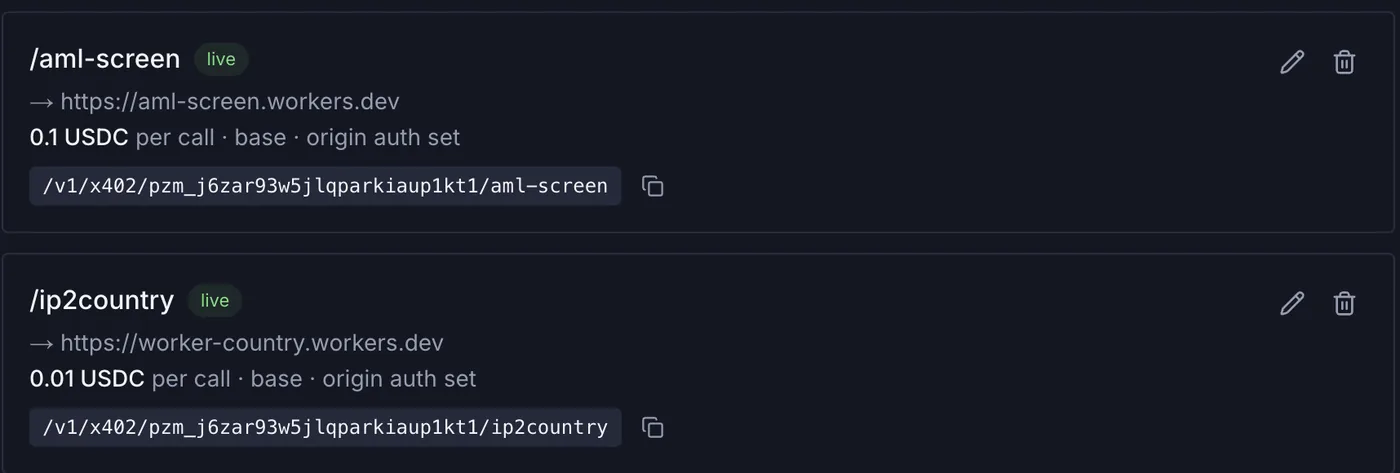
Where Payzum sits, precisely
Payzum is the middleware in front of a client's API, and it is not the facilitator. That distinction gets blurred in every write-up of this market, so it is worth stating in the exact terms the product uses.
You configure your existing endpoint, your API key and a price. Payzum publishes an x402 URL, answers the agent with a 402 and its payment terms, settles through an external facilitator, then proxies the paid call to your real endpoint with your credentials. Settlement is USDC on Base and it goes to the address you configured. Nothing is pooled, batched into a revenue balance or held for a payout schedule, which is why a payment is final when the call is served.
Against a marketplace, the difference is what sits between the call and the money. There is no platform account to provision, no listing review and no billing cycle. There is also no enterprise shelf, so an agent has to find your URL. For a seller priced above the crossover, that trade usually pays.
Objections that come up in every conversation
Does listing on AWS mean I stop owning the customer?
You keep the endpoint and the price. What AWS owns is the agreement, the invoice and the approval path, and your product appears to the buyer as a Marketplace line item rather than as you. For enterprise buyers that is the reason they can buy at all.
Is 3% cheaper than a card processor?
On the percentage it is, but a card processor never charged a cent per call. The comparison that matters for a per-request product is against the settlement cost at your ticket size, which is why the crossover table above exists.
Can I use both rails at once?
Yes, with two products on the AWS side because of the access-model rule. The endpoint itself is the same code, and a paid call from either rail can hit it. What you cannot do is route an AWS purchase through a different payment path: the token has to be verified by the endpoint.
What happens to a call that fails after the agent paid?
On-chain the payment is final, so the answer is a refund you initiate on your own terms rather than a reversal. AWS keeps its standard refund process, where a billing adjustment applies to an invoice and not to an individual payment.
Frequently asked questions
What is AWS Marketplace x402?
It is the AWS feature, launched on November 19, 2026, that lets AI agents buy x402-enabled products listed on AWS Marketplace and charge each request to the buyer's AWS bill in US dollars. The seller sets a signed fixed price per request, and AWS meters the charge and pays out through standard Marketplace disbursement.
How much does AWS charge a seller for agent purchases?
A 3% listing fee on the pre-tax contract value for software-as-a-service public offers, a rate the fee documentation states also applies to Agentic Commerce products. Regional listing fees are additive. The fee is invoiced separately from the disbursement.
Can I use metered or per-token pricing on AWS Marketplace?
Not at launch. AWS Billing supports the x402 exact scheme, where the seller quotes a fixed price for each request. The usage-based upto scheme exists in the protocol but is not part of this payment option, and MPP is not supported for Marketplace products.
Is Payzum the x402 facilitator?
No. Payzum is the middleware and proxy in front of the client's API. On-chain settlement runs through an external facilitator, currently Coinbase's, and the USDC lands directly in the merchant's own wallet. Payzum publishes the x402 URL, returns the 402, verifies the payment and forwards the paid call with the client's credentials.
How large are agent payments over x402 today?
Small, by both credible measures. Visa's Cuy Sheffield put all on-chain agent volume across x402 and MPP at about $50,000 a week on November 24, 2026, flat for six to eight months. A Base-only sample for 15 to 22 November counted $218,452 in eight days, 77% of it through one gift-card seller.
Do I need a wallet to sell to agents?
On AWS Marketplace no, because the buyer pays on a cloud invoice. On a direct x402 endpoint yes, but it is an address you control rather than an account you open: settlement is USDC on Base, and the merchant never holds a balance with the processor.
Book 20 minutes and price your endpoint for both rails
The fee shape only decides half of it. The other half is where the money lands and how fast. Bring your price per call and we will work through the crossover, the listing requirements and what a direct x402 route would settle into your wallet from the first call.
Calendar not loading? Book directly here · [email protected]
This article analyses AWS's public documentation and coverage of the November 19, 2026 launch of AWS Billing in Amazon Bedrock AgentCore payments, and statements made on the Stabledash Neo podcast and published in the Infoharmoni Atlas brief for 15 to 22 November 2026. Fees, limits and scheme support reflect those sources on November 26, 2026 and may change. The volume figures use different methods and are not additive. This is not financial or legal advice. Payzum is the middleware and proxy in front of a client's API and is not the x402 facilitator; on-chain settlement is handled by an external facilitator. Payzum is not affiliated with Amazon Web Services or Visa.