
Stablecoin rules for AI agents: a Fed president says they are missing, and what a paid-endpoint seller can do meanwhile
Key takeaways
- The gap is official now: a Federal Reserve Bank president said on November 5 that current US rules do not comprehensively address smart contracts or agentic AI in payments.
- The money is still small: October 2026 x402 volume was 5.1 million payments worth $274,000, about 5.4 cents each. A seller earning $1,000 a month needs roughly 18,600 calls.
- Hammack also doubted that foreign holders can use the GENIUS Act redemption right without a US dollar bank account, so a seller outside the US needs its own exit route.
On November 5, 2026, Cleveland Fed President Beth Hammack spoke at the SNB and Its Watchers conference. The remarks were about stablecoins and the dollar's role as a safe haven, and they included a passage on AI. As Crypto Briefing reports, Hammack named two features that could raise demand for stablecoins: smart contracts, and what the speech called agentic workflows, where software agents send and receive payments on their own.
What Hammack said, and what the speech left open
The headline claim is short. AI agents using stablecoins would mark a major shift in how money moves. The caveat comes right after it: current US rules do not comprehensively address smart contracts or agentic AI in payments. The Cleveland Fed headline as reposted by Forex Factory frames the whole talk around the dollar's status, which Hammack tied to the rule of law, deep markets and central bank independence.
Two other points matter to a seller. First, Hammack suggested that more stablecoin demand could mean more demand for US dollar assets. Second, Crypto Briefing reports a worry about foreign users: they may not get the full benefit of the GENIUS Act's redemption provisions if they cannot deposit the proceeds into a US dollar bank account. Compliant coins may then concentrate inside the US, while noncompliant ones keep serving users abroad.
Nobody announced a rule. A regional Fed president described a gap, in public, in the same week an agent-payments tracker showed how little money crosses it.
October in dollars: what x402 actually settled
On November 3, Blockchain.News summarized a Fireblocks analysis of x402, the protocol where a server answers a request with an HTTP 402 and a price, and the client pays before the call goes through. Lifetime, x402 has processed more than 196 million transactions across 12 chains and settled more than $42 million.
The shape of that total is odd. November 2025 hit $20.5 million over 52.6 million transactions, and December added $9.4 million over 54.2 million. Decrypt, citing the same data, says more than half of lifetime volume came from a late-2025 frenzy around a token minted through x402. Monthly transactions then fell 92% from the December peak and settled between 4 and 6 million. October 2026 logged 5.1 million transactions worth $274,000.
Allium's third-quarter count, also quoted by Blockchain.News, lines up: agent payments doubled to 68.3 million while their value came to $3.7 million, about five cents each. Fireblocks adds a warning. Public chain records blend routine automation, speculative bot activity and real agent spending, so none of these totals is a clean measure of demand. Our earlier piece on three competing x402 counts covers how to screen your own receipts.
A worked example: how many paid calls make $1,000 a month
October's average payment was $274,000 divided by 5.1 million, or $0.0537. That is the market's real ticket size today. The table turns it into the volume a seller needs. It is plain arithmetic on the Fireblocks figures, not a forecast.
| Price per call | Calls for $1,000 a month | Calls per day |
|---|---|---|
| $0.01 | 100,000 | 3,333 |
| $0.054 (October average) | 18,600 | 620 |
| $0.10 | 10,000 | 333 |
| $0.50 | 2,000 | 67 |
At the October average, $1,000 is 0.37% of everything x402 settled that month. So one seller reaching it would hold a visible slice of the whole market. The practical reading is that per-call prices below a few cents need real traffic, and that a pricier call, such as a report or a dataset slice, reaches the same revenue with far fewer payments to log, reconcile and explain.
Where redemption stops at the border
The GENIUS Act requires payment stablecoins to be redeemable for dollars. The OCC's release NR 2026-92 covers the issuer rule that puts that into practice from January 18, 2027, and our analysis of the OCC rule walks through it. Hammack's point is narrower and more practical: a right to redeem is worth little if the holder has nowhere to land the dollars.
Think of a developer in Lagos or Bogotá who sells an API to agents and receives USDC. Redemption at the issuer needs an account the issuer can pay into. If the seller has no US dollar bank account, the legal right and the usable right diverge. The seller then relies on exchanges, local brokers or peer-to-peer markets, each with its own spread, limits and know-your-customer steps.
The exit is part of the product. A seller who has never moved a small test amount out to local currency does not yet know what a payment is worth. Do the test before launch, then again after any change of country or provider.
Where "silent" rules leave a seller of paid endpoints
The rule gap leaves open questions a buyer's lawyer may ask later. Who authorized this agent to spend? Who is liable if the agent pays for the wrong call? What happens when a paid request fails after settlement? Today the answers come from your terms, your logs and the facilitator's own rules, not from a statute.
In x402 the flow is four steps: the client requests, the server replies 402 with a price, accepted token and wallet address, the client signs a payment and retries, and the server delivers once payment is verified. A third-party facilitator verifies and settles on chain, so the seller never runs crypto infrastructure. The agent is just a wallet. You never learn who stands behind it, and no rule yet says you should.
Five things to do while the rules are silent
- Publish a terms page for the paid endpoint. State what a call returns, whether a failed call is refunded, the rate limits, and an email for disputes.
- Keep one receipt line per paid call: transaction hash, time, price and route. It is your evidence for accountants, auditors and the odd angry buyer.
- Price per call so that nobody owes you anything. A payment-before-delivery model removes credit risk, so do not add invoicing on top without a reason.
- Test your exit. Move a small balance to local currency, record the spread and the time, and write the route down.
- Set a sweep schedule in days so a balance never sits long. The reasoning is the same as in our OCC piece: your exposure to an issuer problem is the balance times the time it sits.
Hammack's two gaps, and the seller's move for each
| Gap named | What it means in practice | Seller's move |
|---|---|---|
| No comprehensive rules for agentic payments | Terms and logs carry the weight a statute would | Terms page, receipt line per call |
| Redemption may not reach foreign holders | The dollar value of USDC depends on your exit route | Test a withdrawal, record the spread |
| Compliant and noncompliant coins may split by region | The token buyers hold may not be the one you want | Name the token and chain you accept |
| Volume is mostly noise | Totals do not predict your traffic | Forecast from your own call logs |
How a paid endpoint goes live on Payzum
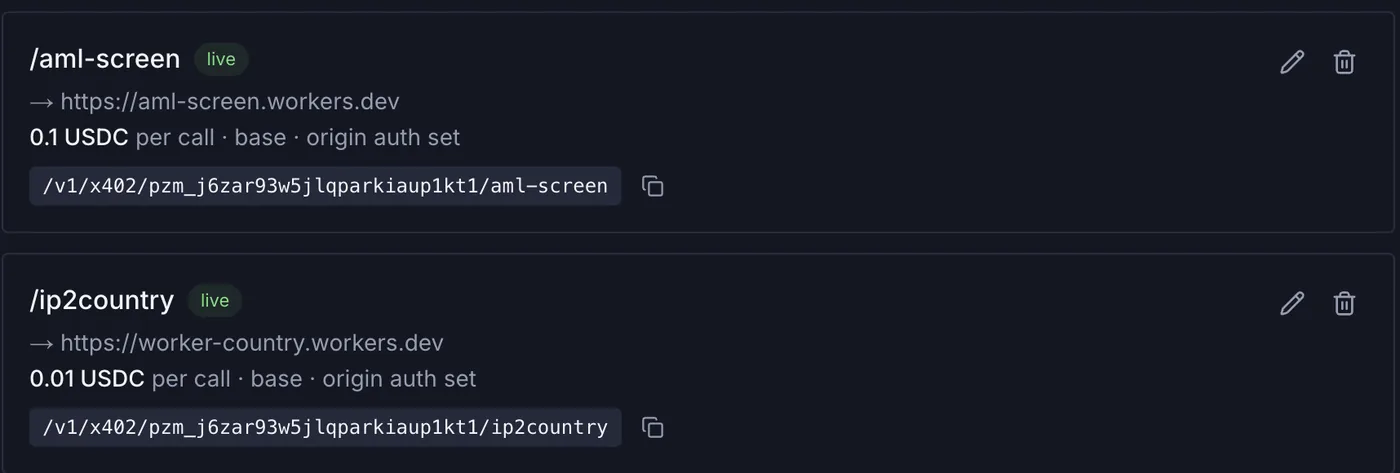
Payzum sits in front of your API as middleware, not as the facilitator. You enter your existing endpoint, your API key or bearer token and a price. Payzum publishes an x402 URL and returns the 402. The payment settles through an external facilitator, currently Coinbase's, and Payzum then proxies the paid call to your real endpoint with your key. There is no code to write and no protocol to implement.
Agents pay in USDC on Base, straight to a wallet you control. Payzum never holds the funds. That wallet choice is where your exit plan starts, so decide it before you publish the URL. Details are on the x402 page.
Objections worth hearing
"If the market is $274,000 a month, why bother?"
Because the setup is a dashboard configuration, and a priced endpoint starts collecting the day it goes live. Do not budget on the channel yet.
"Should I wait for US rules on agents?"
Nothing in the speech tells a seller to wait. Your own counsel should answer that for your jurisdiction. The checklist above is useful whatever the rules turn out to say.
Frequently asked questions
What did Beth Hammack say about AI agents and stablecoins?
On November 5, 2026, the Cleveland Fed president said AI agents using stablecoins would mark a major shift in how money moves, and that current US rules do not comprehensively address smart contracts or agentic AI in payments. She also questioned whether foreign holders can use the GENIUS Act's redemption provisions without a US dollar bank account.
Do US rules cover AI agent payments with stablecoins?
Not comprehensively, according to Hammack's November 5 remarks. The GENIUS Act and the OCC's rule govern issuers. They say little about who is responsible when an AI agent pays, so a seller relies on its own terms, logs and the facilitator's rules.
How much did x402 settle in October 2026?
Fireblocks data, reported by Blockchain.News on November 3, shows 5.1 million transactions worth $274,000 in October 2026, about 5.4 cents each. Lifetime totals are above 196 million transactions and $42 million, with more than half of the volume from a late-2025 burst.
Is Payzum the x402 facilitator?
No. Payzum is the middleware in front of your API. It publishes the x402 URL, returns the 402, settles through an external facilitator (currently Coinbase's) and proxies the paid call to your endpoint with your key. Payments go to a wallet you control.
Price the call, then plan the exit
A seller of paid endpoints cannot wait for statutes. Terms, receipts and a tested withdrawal route do most of the work. Book 20 minutes with our team and we will set up the endpoint with you.
Calendar not loading? Book a meeting directly · [email protected]
This article analyzes reports of Beth Hammack's November 5, 2026 remarks (Crypto Briefing, Forex Factory), Blockchain.News' and Decrypt's reports of Fireblocks and Allium data, and the OCC's release NR 2026-92. The Cleveland Fed's own speech page could not be retrieved when this was written, so quotes are paraphrased from press coverage. It is not legal, tax or financial advice.