
How do I pay suppliers in USDC and match each payment to their invoice?
Key takeaways
- Paying suppliers cross-border is the use case businesses name most often for stablecoins: 53% of 521 executives surveyed by EY-Parthenon between July and August 2026 had used or were exploring it.
- A standard token transfer carries an address and an amount, with no invoice field. The invoice number has to be attached when you build the run.
- Payzum's payout CSV has three columns. The optional label travels with each recipient into the settlement report, which is what makes a month-end match possible without a block explorer.
- A payout run is deposit-and-distribute, not non-custodial: the deposit sits in a derived address or an escrow contract only until the batches finish.
Paying a supplier is easy; proving which invoice you paid is not
Allium counted $482 billion in stablecoin payments between January and September 2026, up 45% on the same stretch a year earlier. Payment count rose 71%, and the average payment fell from $544 to $462. A payment factory looks like this: many small transfers, every day.
Business payments are already the bigger half of that traffic. In Visa's release of 1 October 2026, Allium's breakdown puts supplier payments at $28 billion, behind service fees at $56 billion and payroll at $43 billion. B2B flows had the highest cross-border share of any category Allium analysed, at 43%.
Payzum is a non-custodial, stablecoin-first crypto payment processor: payments settle directly to wallets the merchant controls. The edge cases below are about the other direction, where your company is the payer and an invoice is the reason.
On an Ethereum-style network, a token transfer carries a sender, a recipient and an amount. Nothing else. Circle publishes a separate USDC contract address for every chain it issues on, from Base to Polygon to Avalanche, so the token you send is already pinned to one network. A transfer of 4,200 USDC on Polygon says nothing about invoice 2026-114.
Solana lets a sender attach a memo, and its payment docs say wallets and explorers can surface it. That only helps when the payer types one, and in accounts payable the payer is you. You build the file, so the invoice number can go in before the money leaves.
What one wrong address costs when you pay forty suppliers a month
The FBI's 2025 Internet Crime Report records 24,768 business email compromise complaints and $3.05 billion in losses, with 86% of that loss moving by wire transfer. The mechanism is boring and effective: an email that looks like it comes from a known supplier, with new payment instructions attached. A bank can sometimes recall a wire. A chain cannot reverse a transfer, and no one answers a recall request.
Speed is not the bottleneck in most AP departments either. UK statistics published on 14 July 2026 show large businesses took a median of 32 days to pay suppliers in 2025, and paid 15% of invoices late by number and 14% by value. Manufacturing averaged 45 days. A payment that leaves on day 31 because someone was still hunting for a reference is a late payment with extra steps.
The design question is where the invoice number lives when the money moves. Put it in the file and it survives. Leave it in an email thread and it does not.
Why your bank file and a wallet transfer fail in opposite directions
A bank payment file gives you structured reference fields, a submission cut-off, a per-transfer charge and a recall process that may work if you notice within hours. It also gives you correspondent hops and a weekend. A wallet transfer gives you a confirmed balance in seconds, any day, for a network fee measured in cents on Base, Polygon or Solana. What it does not give you is a reference field, a cut-off you can miss, or a way to ask for the money back.
Both failure modes land on the same desk: the person reconciling the bank statement or the wallet history at month end. Treat the payment run as the record instead of the chain. Build a batch where every line already knows its invoice, approve the batch, fund it once, and keep the output file. Paying suppliers from a CSV works for that reason, and a series of one-off transfers from a wallet does not.
How Payzum carries an invoice number through a USDC payout
The payout product takes a CSV with three columns. address is required, amount is required, and label is optional free text that follows the recipient into your audit trail. Payzum validates every address on upload, so a truncated or mistyped address fails before a batch is built, instead of disappearing on-chain. Mixed-case EVM addresses are checksummed under ERC-55, which the proposal puts at a 0.0247% chance that a mistyped address still passes the check.
One file equals one chain. Stablecoin payouts run in USDC or USDT on Polygon, Arbitrum, Optimism, Base, BNB Chain and Avalanche. The UTXO rail covers Bitcoin, Litecoin and Dogecoin, and it has a testnet, so a first run can be rehearsed with coins that carry no value.
Before anything moves, Payzum prices the run: the sum your suppliers receive, the estimated network fee across every batch, and the service fee quoted in basis points of the recipient sum. The three add up to the single amount to deposit. A run waits in quoted, then pending deposit, then executing, and ends in completed. It can also land in underfunded if the deposit falls short, expired if the funding window closes, or partial failed if a batch does not settle. A short deposit never pays an arbitrary slice of your list.
Custody deserves a plain sentence, because it differs from the rest of the product. Accepting a payment is non-custodial end to end: the customer pays into a wallet you control. A payout is a deposit-and-distribute operation. On UTXO chains you fund a derived deposit address that Payzum can sign from while the batches execute. On EVM chains the deposit goes into an on-chain escrow contract, and Payzum's operator wallet covers the gas. The money sits there for the length of the run and no longer.
The output is a settlement CSV, one line per recipient, plus signed webhooks for each state change. An idempotency key stops a retried API call from creating a second run. On the accounting side, the ledger records the payout with its transaction hash and your label, values it in one of 31 reporting currencies at the ECB reference rate for the event date, and exports as CSV, JSON or OFX. A payment of 4,200 USDC still carries the 0.5% acceptance fee on the sales side of the business, deducted from the amount received, plus network gas. Payout pricing is quoted in the run itself, before you fund it.
From the approved bill list to a funded run in five steps
- Close the approval list first. Take only invoices that passed your normal controls: purchase order matched, goods or service received, amount agreed. The payment file is the last step of AP.
- Pick one chain for the whole file. If half your suppliers gave you a Polygon address and half gave you Base, that is two runs. Match the chain to the amount, with cheap networks for small recurring bills and the network your supplier actually uses for large ones.
- Fill three columns and nothing else: address, amount in decimal form, and the invoice number in the label. Keep one row per invoice, so two invoices to the same supplier become two rows with the same address.
- Read the quote before you fund. Check the recipient count, the sum and the fee lines against your AP total. A count that is one row short is the cheapest error you will catch all month.
- Fund once and keep the outputs. Send the exact quoted total to the deposit address. When the run reaches completed, export the settlement CSV and file it next to the approval list.
The file has three columns. Amounts and addresses below are illustrative, and the label is where the supplier's invoice number goes.
address,amount,label
0x833589fCD6eDb6E08f4c7C32D4f71b54bdA02913,4200.00,INV-2026-114
0x3c499c542cEF5E3811e1192ce70d8cC03d5c3359,1850.00,INV-2026-118
0xaf88d065e77c8cC2239327C5EDb3A432268e5831,975.50,INV-2026-121
# one chain per file · amount in decimal · label is free text
Two rules keep that file usable for a real AP team. Never reuse an invoice number in the label for a second payment, because the label is the only thing tying the on-chain line to the bill. And never edit an address that a supplier sent you: store it once in a vendor master record, and require a second approver to change it. Address-change fraud depends on the opposite habit.
Four supplier situations where the label does the work
The mechanics are the same every time. What changes is the reason a row exists and what a mismatch looks like.
- A design studio on a monthly retainer sends one invoice per month, so it gets one row and one label. When a change order is approved late and a second invoice arrives, the second row carries the second number and the settlement file shows both.
- A freight forwarder billing landed cost sends its invoice after the container clears, bundling freight, terminal handling and a demurrage charge that appeared mid-transit. Pay it as one line, put the forwarder's invoice number in the label, and attach the breakdown in your AP system so a later dispute has a payment to point at.
- A factory taking a deposit and a balance needs two rows, two labels and two dates: thirty percent on order, seventy percent before shipment. It sees two transfers that each match an invoice.
- A bench of weekly contractors means fifteen people in different countries, mostly under $600. One run per week, one row per person, and a label carrying the week and the engagement reference. Each recipient needs a wallet address, not an account with Payzum, so nobody waits in an onboarding queue.
For the recurring side of that list, the mass payouts guide covers batch mechanics in more depth. If your suppliers are mostly remote contractors rather than companies, the contractor payout walkthrough is the closer read.
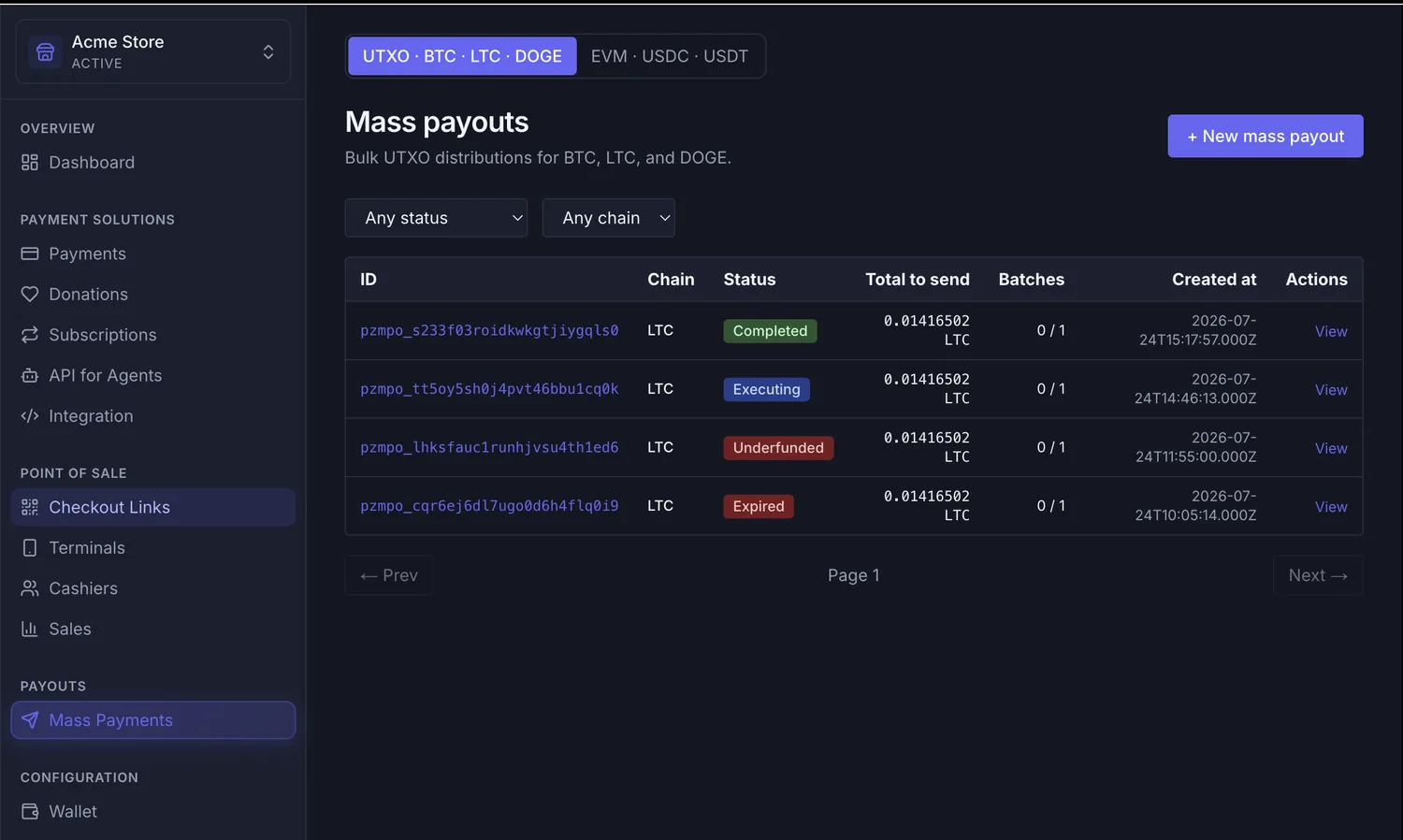
Ten September invoices, one matching table
This run belongs to a mid-sized importer, built on Polygon in USDC. Totals are invented for illustration.
| Supplier | Invoice | Label sent | Amount (USDC) | Run status | Matched to |
|---|---|---|---|---|---|
| Packaging factory | INV-2026-114 | INV-2026-114 | 4,200.00 | Completed | Bill 8841 |
| Packaging factory | INV-2026-119 | INV-2026-119 | 2,100.00 | Completed | Bill 8842 |
| Freight forwarder | FF-88213 | FF-88213 | 1,850.00 | Completed | Bill 8846 |
| Label printer | LP-4471 | LP-4471 | 975.50 | Completed | Bill 8847 |
| Customs broker | CB-2026-0912 | CB-2026-0912 | 640.00 | Completed | Bill 8851 |
| Warehouse landlord | RENT-OCT | RENT-OCT | 3,400.00 | Completed | Bill 8852 |
| IT support | IT-77120 | IT-77120 | 1,200.00 | Completed | Bill 8855 |
| Photographer | PH-2026-33 | PH-2026-33 | 750.00 | Completed | Bill 8856 |
| Packaging factory | INV-2026-123 | INV-2026-123 | 2,400.00 | Underfunded | Open |
| Trade show booth | TS-5510 | TS-5510 | 1,300.00 | Expired | Open |
| Recipient sum | 18,815.50 | 8 of 10 |
Eight rows settle, and the settlement CSV carries those eight labels plus the transaction hash of each batch. The two open rows show what the state machine is for. The underfunded run did not pay part of the list at random: it stopped, told you how much the deposit fell short on that row, and waited. The expired run is a funding window that closed before the money arrived, usually because someone funded from a different wallet than the one they had planned.
The same month paid by wire looks like ten transfers, ten confirmation emails, one or two that land short because an intermediary bank took a fee, and a reference line that some suppliers quote back and others do not. Matching is hard on both rails. The difference is that a payment file lets you enforce the match before the money moves.
USDC supplier payouts next to a bank file, a wire and a payout platform
| Bank file or wire | Payout platform | Payzum stablecoin payouts | |
|---|---|---|---|
| What the supplier needs | A bank account that accepts the corridor | An account on the platform, verified | A wallet address on one supported chain |
| Invoice reference | Structured reference field, supplied by the payer's bank file | Free-text memo, limits vary | Free-text label per row, carried into the settlement CSV |
| Arrival | Same day to five business days, cut-offs apply | Depends on the underlying rail | As fast as the chain confirms, any day |
| Where funds sit mid-run | Your bank, until it debits | The platform's pooled balance | Derived deposit address or on-chain escrow, only while the run executes |
| Recall after sending | Possible within hours, not guaranteed | Depends on the provider | None. A sent transfer is final |
| Reconciliation output | Bank statement plus your own file | Provider report | Settlement CSV, signed webhooks, ledger export with transaction hashes |
A bank file gives you a recall process and a reference standard. Stablecoin payouts give you settlement speed and a reference you control. If you need both, run stablecoins for the suppliers who invoice in dollars and accept a wallet, and keep the bank rail for the ones who do not.
Questions the controller asks before signing off the first run
"We cannot hand a volatile asset to a supplier."
Then do not send one. USDC and USDT track the dollar, so the amount on the invoice and the amount that lands are the same number. A supplier who wants local currency converts it with their own provider, on their own schedule. You are not responsible for their off-ramp, and you should say so in the payment terms rather than assume it.
"Who holds the money while the batch runs?"
Payzum does, for the length of the run, and only then. That is what a deposit-and-distribute payout is. If your treasury policy forbids any third party holding funds even briefly, say that up front and keep this rail for smaller, high-frequency bills while wires handle the large ones. A provider that calls a payout non-custodial is describing the wrong product.
"What if our ERP cannot read a crypto payout?"
The ledger export is the interface. It arrives as CSV, JSON or OFX, with invoice IDs, order references and transaction hashes, and the payouts API returns the same data if your team prefers to pull it. The accounting-software walkthrough covers the import side.
Where a supplier run starts to pay for itself
Two signals usually appear first. Your AP team stops asking suppliers to confirm receipt, because the settlement file already says what landed and when. And the "please resend the invoice" emails drop, because the invoice number travelled with the payment instead of waiting in a mailbox.
Batching carries the rest. A run with ten suppliers and a run with two hundred use the same three columns and the same quote step. What changes is the approval inside your own systems, which stays yours: Payzum validates addresses and executes a funded list, and it does not decide whether a bill should be paid.
Frequently asked questions
How do I pay suppliers in USDC and match each payment to their invoice?
Build one CSV with the supplier's address, the amount and their invoice number in the label column, then upload it as a payout run. Payzum validates every address, quotes the total to deposit, and pays each recipient into their own wallet. The settlement CSV returns the labels with the transaction hashes, so each line matches an invoice.
What should a supplier payment CSV contain?
Three columns and one header row: address, amount and label. The address must belong to the chain you selected, the amount goes in decimal form such as 4200.00, and the label is optional free text that follows the recipient into the audit trail. Put the supplier's invoice number there. One file can only contain addresses from one chain.
Can I pay two hundred suppliers in one run?
Yes. A run is priced as a recipient sum plus estimated network fees plus a service fee, and Payzum splits the list into batches and broadcasts them. The orders list shows progress per batch. Large lists are still one file and one funding deposit, as long as every address is on the same chain.
Do suppliers need a Payzum account to receive USDC?
No. A wallet address is the whole requirement, so nobody joins an onboarding queue or passes a check on your side. That is also the limit to be clear about: you cannot verify who controls that wallet, so keep addresses in a vendor master record and require a second approver for any change.
Does Payzum hold the funds while a payout runs?
For the length of the run, yes. A payout is deposit-and-distribute: on UTXO chains you fund a derived deposit address, and on EVM chains you deposit into an on-chain escrow contract while the operator wallet covers gas. Accepting customer payments is different and stays non-custodial, with funds settling into a wallet you control.
What happens if the deposit is short or the run expires?
The order moves to underfunded rather than paying part of your list, and a funding window that closes first leaves it expired. Both states appear in the orders list and arrive as signed webhooks. Nothing half-pays by accident, so you can top up or rebuild the run without wondering which suppliers were paid.
Design the supplier run before the next payment date
Every AP team has its own approval chain, its own supplier mix and its own definition of a matched invoice. Book 20 minutes with our team and we will design the CSV, the approval step and the settlement export around how your finance team already works.
Can't see the calendar? Book directly here · [email protected]